


Talk to Your Thermostat and Stay Cozy All Year Long
Talk to Your Thermostat and Stay Cozy All Year Long
Choosing the Best Thermostat Alexa Compatible Model for Your Home
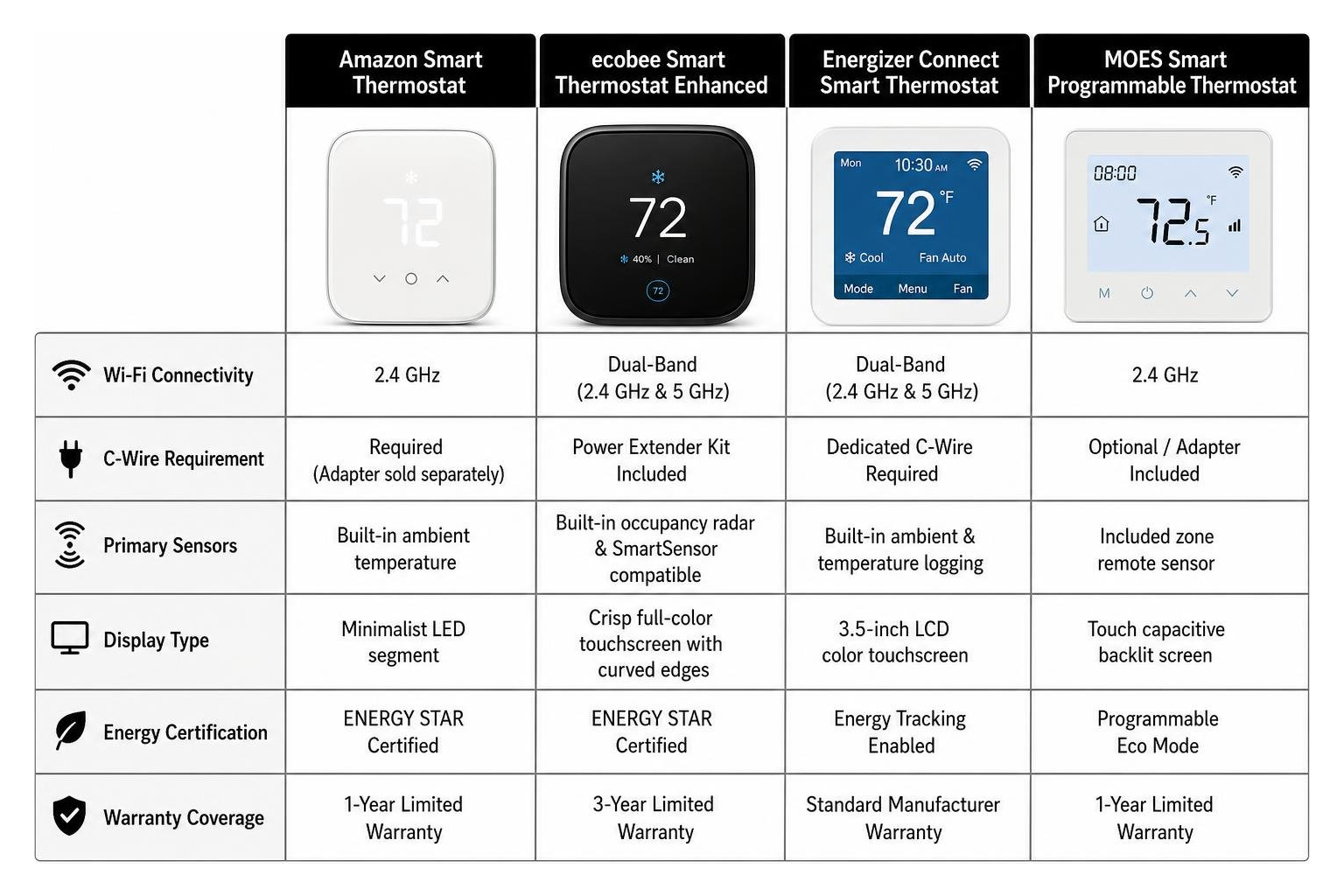
Selecting the right smart climate hub comes down to balancing hardware capabilities, connectivity, and power requirements. Whether you want a simple voice-activated device or an advanced system with distributed room sensors, several standout choices deliver reliable integration with Amazon Echo devices.
| Feature / Model | Amazon Smart Thermostat | ecobee Smart Thermostat Enhanced | Energizer Connect 5GHz Smart Thermostat | MOES Smart Thermostat |
|---|---|---|---|---|
| Wi-Fi Connectivity | 2.4 GHz | Dual-Band (2.4 GHz & 5 GHz) | Dual-Band (2.4 GHz & 5 GHz) | 2.4 GHz |
| C-Wire Requirement | Required (Adapter sold separately) | Power Extender Kit Included | Dedicated C-Wire Required | Optional / Adapter Included |
| Primary Sensors | Built-in ambient temperature | Built-in occupancy radar & SmartSensor compatible | Built-in ambient & temperature logging | Included zone remote sensor |
| Display Type | Minimalist LED segment | Crisp full-color touchscreen with curved edges | 3.5-inch LCD color touchscreen | Touch capacitive backlit screen |
| Energy Certification | ENERGY STAR Certified | ENERGY STAR Certified | Energy Tracking Enabled | Programmable Eco Mode |
| Warranty Coverage | 1-Year Limited Warranty | 3-Year Limited Warranty | Standard Manufacturer Warranty | 1-Year Limited Warranty |
Finding an ideal thermostat alexa compatible unit means matching these features to how your household actually uses energy every day. A well-matched model should also work smoothly with your existing heating and cooling equipment, so it is worth reviewing your current wiring and control setup before making a final decision.
Everyday Thermostat Alexa Compatible Efficiency
For homeowners looking for an entry-level upgrade that pairs effortlessly with an existing Amazon smart speaker setup, the Amazon Smart Thermostat offers a streamlined experience. Built with proven smart thermostat technology, this compact unit delivers reliable performance in a clean, minimalist design measuring 3.56 by 3.56 inches.
It features an ENERGY STAR certification, which helps homeowners save consistently on annual utility expenses. The unit connects over standard 2.4 GHz Wi-Fi networks and operates through the Alexa app on your smartphone. Backed by a 1-year limited warranty, it serves as an accessible starting point for hands-free temperature management, earning an 87% recommendation rate from verified retail purchasers. For many households, this type of straightforward control is enough to improve daily comfort while keeping energy use in check.
Advanced Thermostat Alexa Compatible Sensing
When you need deeper control across larger floor plans, the ecobee Smart Thermostat Enhanced takes climate automation to the next level. This device includes advanced onboard occupancy radar that tracks movement and thermal activity in real time.
Ecobee smart thermostats have collectively saved more than 53.9 TWh of energy worldwide, and this model can reduce heating and cooling costs by up to 26%, helping households noticeably lower overall energy use. It sports dual-band Wi-Fi support (2.4 GHz and 5 GHz) and integrates with optional remote SmartSensors to eliminate hot or cold spots in upstairs bedrooms or finished basements. The thermostat includes a 3-year limited warranty and pairs cleanly with other major smart home ecosystems. That flexibility makes it a practical option for homes with multiple smart devices and varying comfort needs from room to room.
Smart Programmable Options
For multi-network households that demand flexible scheduling and modern hardware styling, programmable alternatives provide plenty of control:
- Energizer Connect Smart Thermostat: Boasts a vibrant 3.5-inch LCD touchscreen display and dual-band 5 GHz and 2.4 GHz connectivity. It includes a built-in nightlight—bright enough to guide you through a dark hallway—and allows 7-day, 8-period daily programming with 15-minute scheduling increments.
- MOES Smart Programmable Thermostat: Designed for multi-room balance, this unit includes a wireless zone remote sensor and an optional C-wire setup to regulate temperatures based on occupied spaces rather than an empty hallway.
Installation Requirements, C-Wire Needs, and HVAC Compatibility
Before purchasing any smart climate hardware, verifying your low-voltage wiring is the most critical step. Most Alexa-ready thermostats require a steady 24VAC power supply from your heating and air conditioning equipment to maintain continuous Wi-Fi connectivity and screen illumination.

This uninterrupted power is supplied through a dedicated “C” (Common) wire. If you open your existing thermostat and find only four wires (R, G, Y, and W), you have several options:
- Use an Included Power Extender: Devices like the ecobee include a Power Extender Kit (PEK) right in the box, which adapts standard 4-wire configurations at the furnace control board.
- Add a Standalone Adapter: Units requiring continuous power, such as the Amazon Smart Thermostat, can use an add-on C-wire power adapter kit.
- Schedule Professional Configuration: If your setup involves multi-stage heat pumps, dual-fuel systems, or older boilers, our certified team provides complete thermostat services to safely inspect terminals and balance your electrical load.
Always turn off power at your main circuit breaker panel before removing your old wall plate. Take a clear reference photo of your existing wire terminals and use the included stickers to mark every lead accurately before unhooking the baseplate. If you are unsure about any wiring detail, a professional inspection can help prevent damage to your HVAC control board and ensure the new thermostat communicates reliably with your equipment.
Smart Automation, Occupancy Sensing, and Energy Savings
Automating your HVAC system goes far beyond simple 7-day timers. Modern voice-enabled thermostats use intelligent background routines that actively trim wasted run-time without sacrificing personal comfort.
- Thermostat Hunches: Integrated directly into the Alexa ecosystem, Hunches analyzes smart home activity. If your Echo devices detect no motion, or if you tell Alexa “Goodnight,” the system can automatically shift your heating or air conditioning into an eco-friendly setback mode.
- Eco+ and Demand Response: Premium units balance community grid demand and optimize compressor run times, ensuring that your cooling services operate during lower-cost off-peak hours.
- Geofencing Perimeters: By creating a virtual boundary around your property via your smartphone’s GPS, your thermostat lowers heating output when you leave the driveway and pre-warms the house as you head home.
- Integrated Seasonal Tune-Ups: Even the smartest thermostat cannot overcome a dirty filter or low refrigerant. Pairing smart automation with routine heating services keeps your equipment running smoothly through extreme weather.
These features work best when the thermostat is matched to the actual layout and usage patterns of your home. A single-setpoint system may be sufficient for a compact space, while a dual-setpoint arrangement gives larger households more precise control over heating and cooling thresholds throughout the day.
Voice Directives, Alexa Routines, and App Controls
Smart thermostats communicate with Amazon Echo hardware using standard developer directives defined by the Alexa ThermostatController Interface. These guidelines ensure smooth handling of both single-setpoint and dual-setpoint systems.
When issuing voice commands, Alexa translates your natural speech into precise HVAC control signals:
- “Alexa, set the temperature to 70 degrees.” (Triggers the
SetTargetTemperaturedirective) - “Alexa, raise the temperature by 2 degrees.” (Executes the
AdjustTargetTemperaturedirective) - “Alexa, set the thermostat to Auto mode.” (Engages both heating and cooling setpoints)
- “Alexa, resume schedule.” (Cancels manual holds and returns to automated programming)
Beyond direct voice commands, the Alexa Energy Dashboard aggregates runtime patterns across your household. You can group your thermostat into custom routines—such as dimming smart lights, locking the front door, and lowering the heat to 65 degrees with a single phrase like “Alexa, I’m heading out.” Over time, these small automations add up to more consistent comfort and fewer manual adjustments.
Frequently Asked Questions About Alexa Thermostats
For additional guidance on keeping your home comfort equipment running smoothly, browse our HVAC FAQ or review common user questions below.
Do all smart thermostats require a C-wire to work with Alexa?
Most Alexa-enabled smart thermostats require continuous low-voltage power from a C-wire to maintain an active Wi-Fi connection and respond to instant voice commands. If your wall lacks a dedicated C-wire, you can install a power adapter kit or choose a model that includes a power extender module. Checking your wiring before installation can save time and prevent connectivity issues later.
How do Alexa Hunches and smart sensors lower energy bills?
Thermostat Hunches and remote occupancy sensors track presence throughout your home. When rooms are empty or the household is asleep, the system applies an automatic temperature setback, preventing unnecessary heating or cooling and saving significant amounts each year on utility bills. This approach is especially useful in homes where daily schedules change often.
Can I control dual-setpoint heating and cooling systems with voice commands?
Yes. Dual-setpoint systems maintain both an upper cooling threshold and a lower heating threshold. Using the Alexa ThermostatController interface, you can specify both boundaries or tell Alexa to adjust individual target points while your equipment remains in auto-changeover mode. This gives you precise control without needing to switch modes manually.
Conclusion
Upgrading to an Alexa-compatible thermostat brings effortless comfort, convenient voice controls, and measurable reductions in monthly energy bills. Whether you want an everyday ENERGY STAR controller or an advanced multi-room sensor setup, picking the right unit creates a smarter, cozier living space. A properly installed smart thermostat also helps your heating and cooling equipment run more efficiently, which can extend its service life and reduce unnecessary wear.
When you are ready to evaluate your system’s wiring, optimize your airflow, or install a new system, contact us at New Comfort Heating & Cooling. We provide reliable HVAC services with 24/7 live phone support, same-day service, and clear, transparent pricing. Elevate your indoor comfort all year long by exploring our comprehensive cooling solutions today.