Circulator Pump Problems: Replacement Costs and What to Expect
What Does a Boiler Circulating Pump Replacement Actually Cost?
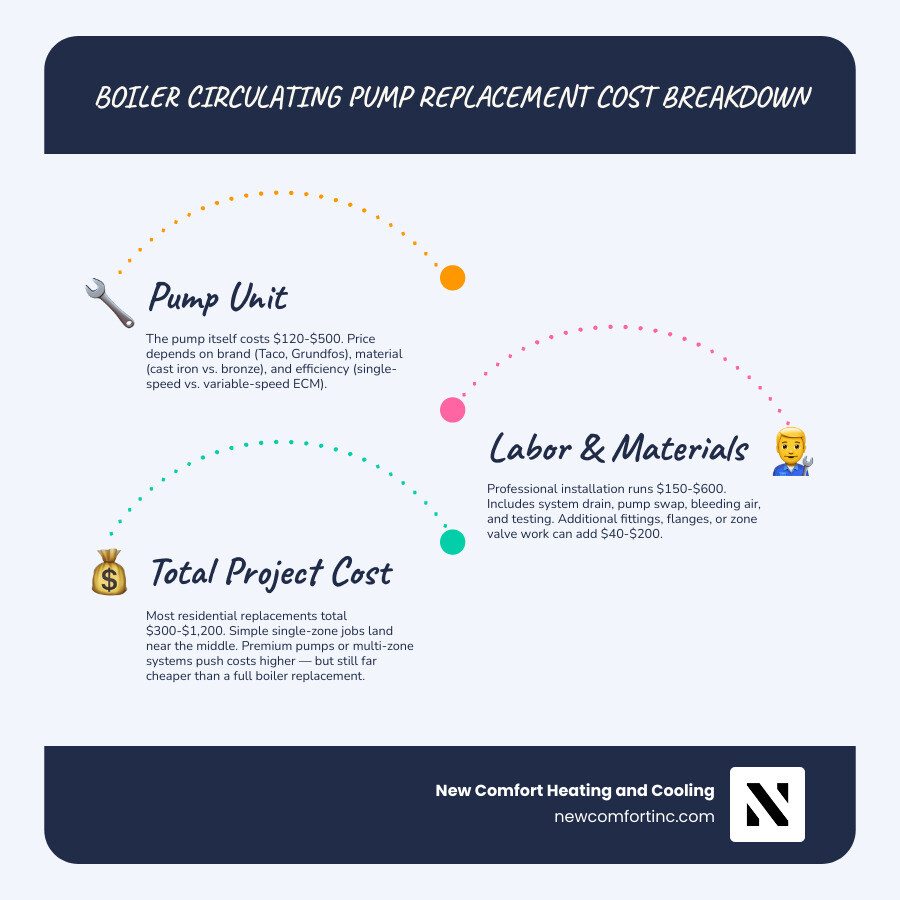
Boiler circulating pump replacement cost typically depends on your pump type, system complexity, and labor rates in your area.
Here's a quick snapshot of the components that make up the total cost before we dive deeper:
- Pump unit (parts only): The cost of the physical pump itself.
- Labor: The professional installation fees.
- Additional materials/fittings: Any extra pipes, flanges, or gaskets needed.
- Permits: If required by your local municipality.
Most standard single-zone residential replacements are relatively straightforward. Complex multi-zone systems or premium variable-speed pumps can push overall expenses higher.
Your circulator pump is the heart of your hydronic heating system. When it fails, hot water stops moving — and your radiators go cold, even if the boiler itself is running fine. That's the frustrating part: the boiler looks like it's working, but no heat is reaching your rooms.
The good news? Replacing a failed circulator pump is almost always far cheaper than replacing the whole boiler.
At New Comfort Heating and Cooling in Justice, Illinois, we believe that understanding boiler circulating pump replacement cost factors helps homeowners avoid overpaying or getting caught off guard by a contractor's quote. Keep reading for a full breakdown of what drives the price — and how to budget smart.
Boiler circulating pump replacement cost helpful reading:
- 24hr hvac repair
- cost to replace furnace fan
What is a Boiler Circulating Pump and How Does It Work?
To understand why a replacement is necessary, it helps to understand what this little machine actually does. In a hydronic heating system, water is heated inside the boiler. However, hot water does not magically travel through your pipes on its own. It needs a push.
That push comes from the boiler circulating pump (also known as a circulator pump).
Most modern residential boilers use a centrifugal pump with a wet-rotor design. In this setup, the water flowing through the system actually lubricates the pump's rotor and bearings, making the unit incredibly quiet and compact.
When your thermostat calls for heat, the pump's electric motor spins an impeller. This spinning action creates centrifugal force, pushing water through your home's closed-loop heating system.
When evaluating a replacement pump, professionals look at two critical performance metrics:
- Flow Rate (measured in GPM, or Gallons Per Minute): This is the volume of water the pump can move through your pipes in one minute.
- Head Pressure (measured in feet of head): This is the amount of resistance (friction) the pump can overcome as it pushes water through the pipes, valves, and elbows of your system.
In a closed-loop system, the pump does not have to fight gravity because the weight of the falling water balances out the rising water. It only has to fight the internal friction of the pipes. However, if you have an open-loop system (such as a domestic hot water recirculation line), the pump must be made of corrosion-resistant materials because fresh, oxygenated water is constantly introduced.
If your home's hydronic system is struggling to distribute heat evenly, our team at New Comfort Heating & Cooling can help diagnose the issue through our comprehensive heating services.
Signs Your Boiler Circulator Pump Needs to Be Replaced
You do not always have to wait until you are shivering in the middle of a classic Chicago freeze to know your pump is on its last legs. Often, your system will drop hints that a breakdown is imminent.
Keep an eye (and ear) out for these common warning signs:
- Metallic Noises: If you hear grinding, squealing, or loud humming coming from your boiler closet, the pump's bearings are likely failing. Limescale buildup can also cause "kettling" or banging noises.
- Cold Spots or No Heat: If some radiators are hot while others remain stone-cold, your pump may lack the power to push water to the furthest zones of your home.
- System Leaks: Check the flanges (the connection points where the pump meets the piping). Rust, mineral deposits, or active dripping around these joints indicate failing gaskets or a cracked pump body.
- Boiler Overheating: If the pump fails completely, hot water sits trapped inside the boiler. The temperature inside the heat exchanger will skyrocket, causing the system to shut down on a safety limit or, worse, blow off steam through the pressure relief valve.
Catching these issues early during routine furnace maintenance can save you from an emergency midnight service call.
Understanding Your Boiler Circulating Pump Replacement Cost
When it comes to the overall boiler circulating pump replacement cost, there is no one-size-fits-all answer. Every hydronic system in the Chicago area is unique, and several key variables will shape the final estimate you receive from an HVAC contractor.
For a deep dive into national and local price structures, you can read the Boiler Circulating Pump Replacement Cost and Price Ranges 2026 – Current Cost . Let's break down the primary factors that influence this investment.
Material and Brand Factors in Boiler Circulating Pump Replacement Cost
The physical pump unit itself makes up a significant portion of the project cost. Several reputable brands dominate the hydronic heating market, each offering different tiers of performance and efficiency:
- Taco: Extremely common in residential systems, Taco pumps (such as the classic Taco 007 series) are known for reliability, ease of service, and budget-friendly parts.
- Grundfos: Another industry heavyweight, Grundfos offers highly reliable options like the UPS series, which features multi-speed controls to fine-tune system flow.
- Bell & Gossett: Often found in larger homes or light commercial applications, these heavy-duty pumps are built to last but lean toward the premium end of the spectrum.
Beyond the brand name, the pump's construction material and motor design play a major role in the price:
- Cast Iron vs. Bronze/Stainless Steel: Cast iron pumps are standard for closed-loop heating systems because the water is de-oxygenated, preventing rust. However, if your pump handles potable domestic water (an open loop), you must use a more expensive bronze or stainless steel model to prevent corrosion.
- Single-Speed vs. Variable-Speed (ECM): Traditional single-speed pumps run at full blast whenever they are on. Modern variable-speed pumps utilize Electronically Commutated Motors (ECM). These smart pumps automatically adjust their speed to match the heating demand of your home, slashing your electricity usage. While they require a higher upfront investment, they pay for themselves over time through lower utility bills.
To explore how these different pump types compare, check out the Boiler Pump Price Guide: Typical Cost Range for Pumps and Installation 2026 – Current Cost .
Labor and Complexity Variables Affecting Boiler Circulating Pump Replacement Cost
The physical installation is where the complexity of your home's piping comes into play. Labor rates for licensed HVAC technicians vary by region, and Chicagoland metro pricing typically aligns with national averages.
Several technical challenges can extend the labor hours required for a swap:
- Corroded Flanges: If your old pump has been leaking for years, the mounting flanges and bolts may be rusted solid. Cutting out and replacing these corroded transitions can add significant time and material requirements to the job.
- Isolation Valves: If your system has working isolation valves on either side of the pump, the technician can simply close them, swap the pump, and open them back up. If those valves are missing or frozen, the entire boiler system must be drained, refilled, and bled of air, which heavily increases labor time.
- System Complexity and Zone Valves: Multi-zone systems with multiple pumps or zone valves require careful electrical wiring and control integration to ensure everything cycles correctly.
For more details on how site conditions impact your final bill, refer to the Gas Boiler Pump Cost: Typical Prices, Ranges, and What Affects the Final Price 2026 - Pick Comfort .
DIY vs. Professional Circulator Pump Replacement
When faced with home repairs, it is tempting to try and save some hard-earned money by taking the DIY route. However, replacing a boiler pump is not quite like changing a faucet. It involves a potentially dangerous combination of high-voltage electricity, high-temperature water under pressure, and precise system plumbing.
Here is how a DIY attempt stacks up against a professional installation:
| Factor | DIY Replacement | Professional Installation |
|---|---|---|
| Safety Risks | High risk of electrical shock, hot water burns, or flooding. | Licensed technicians follow strict safety protocols. |
| Tools Required | Requires specialized pipe wrenches, voltmeters, and potentially soldering gear. | Pros arrive with fully stocked trucks and commercial-grade tools. |
| System Bleeding | Trapped air can block heat and damage the new pump. | Professionals thoroughly purge all air bubbles from the lines. |
| Warranty Protection | Manufacturer warranties may be voided if not installed by a licensed pro. | Includes both equipment warranties and labor guarantees. |
| Time Investment | Can take a full weekend of troubleshooting and hardware store runs. | Usually completed in a few hours. |
If you decide to handle the replacement yourself, you risk damaging your boiler’s control board or improperly sizing the pump, which can lead to premature motor failure. For peace of mind and long-term system reliability, consulting a professional is always the safest bet. You can read more about these risks in the Circulator Pump Replacement Cost Guide – Current Cost .
Frequently Asked Questions about Boiler Circulator Pumps
We get a lot of questions from homeowners in Justice and Chicago about their heating systems. Here are a few of the most common queries we receive. If you have a question not covered here, visit our faq page.
How long does a typical boiler circulator pump last?
A well-maintained, high-quality circulator pump typically lasts between 10 and 15 years. Its actual lifespan depends heavily on your system's water quality. Hard water with high mineral content or systems with excessive air bubbles can cause premature wear on the pump's wet-rotor bearings. Regular annual inspections help ensure you get the maximum lifespan out of your equipment.
Can a failing pump cause the boiler to overheat?
Yes, absolutely. Because the circulator pump is responsible for carrying heat away from the boiler heat exchanger and out to your radiators, a dead pump means that heat has nowhere to go. The water inside the boiler will rapidly heat up, causing the system pressure to spike. Modern boilers have safety limit switches to shut down the burner before things get dangerous, but repeated overheating can crack your heat exchanger.
What is the difference between cast iron and bronze pumps?
Cast iron pumps are designed strictly for closed-loop hydronic heating systems. In these systems, the same water circulates repeatedly, eventually losing its oxygen content. Without oxygen, cast iron does not rust. Bronze or stainless steel pumps are required for open-loop systems (like domestic hot water lines) because fresh, oxygen-rich water is constantly flowing through, which would quickly rust and ruin a cast iron pump.
Conclusion
A failing boiler circulator pump can quickly turn your cozy home into an icebox, but it does not have to mean a budget-busting repair. By understanding the key factors behind boiler circulating pump replacement cost — from brand selection to system complexity — you can make an informed decision that keeps your family warm and your heating system running efficiently.
At New Comfort Heating & Cooling, we pride ourselves on providing the families of Justice and Chicago with transparent, honest pricing that beats out the big-box competitors. We offer 24/7 live phone support and same-day service to ensure you are never left out in the cold.
If your radiators are cold or your boiler room is making strange noises, do not wait for a total system breakdown. Contact us today to schedule a professional diagnostic visit or expert furnace repair.
Let us restore comfort and reliability to your home's heating system: https://newcomfortinc.com/heating/furnace-repair/