Why a 36K BTU Mini Split Might Be the Sweet Spot for Your Home
Is a 36K BTU Mini Split Right for Your Home?
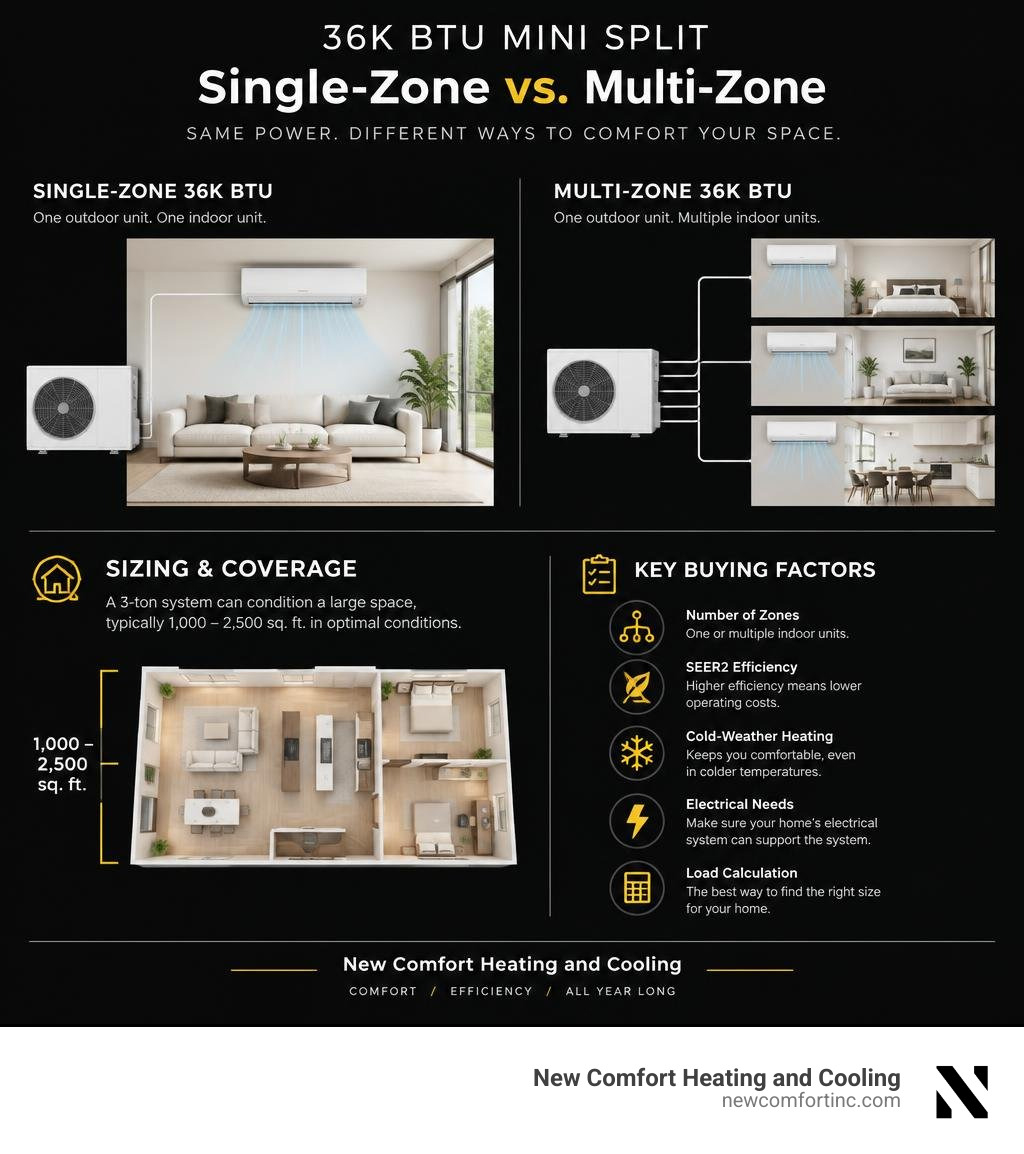
A 36,000 BTU mini split is a 3-ton system that can heat and cool a large open space or serve several rooms with multiple indoor units. It may be a good fit if you want year-round comfort without adding ductwork. But square footage alone cannot tell you whether it is the right size: insulation, windows, layout, and Chicago-area winter temperatures all matter.
As you compare models, look beyond the BTU number. Check the number of zones, SEER2 efficiency, cold-weather heating performance, and electrical needs. A heating and cooling load calculation will help you choose a system that fits your home rather than relying on a coverage claim.
Sizing and Coverage: How Much Space Can a 36k BTU Mini Split Cool and Heat?
A 3-ton ductless system provides substantial heating and cooling capacity. In optimal conditions, a single 36k btu mini split can condition between 1,000 and 2,500 square feet of living space. However, real-world performance depends heavily on the layout of your home, ceiling heights, sun exposure, and how well your structure retains conditioned air.
In open-concept designs, such as a large living room that transitions freely into a dining room and kitchen, a single high-capacity air handler can distribute air effectively. For spaces broken up by hallways, closed doors, and multiple levels, distributing that 36,000 BTU capacity across multiple indoor heads ensures even temperatures without hot or cold pockets.
| Insulation Quality | Ceiling Height | Estimated Coverage Area | Recommended Setup |
|---|---|---|---|
| High (Modern Build) | Standard 8 ft | 2,000 – 2,500 sq. ft. | Single-Zone or Multi-Zone |
| Moderate (Standard) | Standard 8 ft | 1,500 – 2,000 sq. ft. | Multi-Zone (2 to 3 heads) |
| Moderate (Standard) | Vaulted 10–12 ft | 1,200 – 1,600 sq. ft. | Multi-Zone (3 to 4 heads) |
| Low (Older/Historic) | Standard 8 ft | 1,000 – 1,400 sq. ft. | Multi-Zone (3 to 4 heads) |
Calculating Heating and Cooling Loads
Relying solely on general square footage estimates can lead to an improperly sized system. A system that is too small will run continuously during freezing Illinois winters, while an oversized unit will short-cycle, causing poor humidity control and premature wear on components.
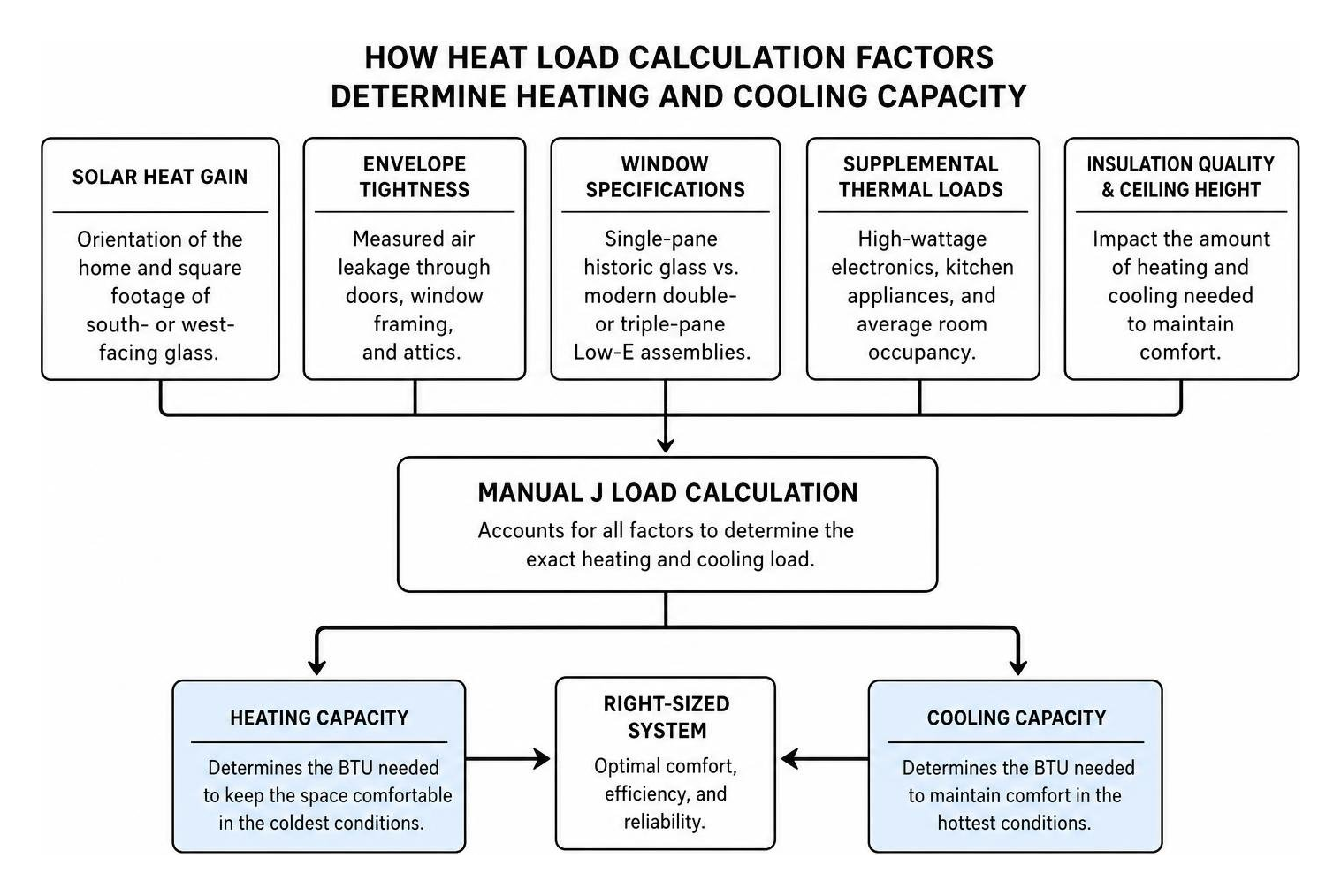
To determine exact requirements, HVAC professionals perform a Manual J load calculation. This process accounts for critical environmental and structural variables:
- Solar Heat Gain: The orientation of your home and the square footage of south- or west-facing glass.
- Envelope Tightness: Measured air leakage through doors, window framing, and attics.
- Window Specifications: Single-pane historic glass versus modern double- or triple-pane Low-E assemblies.
- Supplemental Thermal Loads: High-wattage home electronics, kitchen appliances, and average room occupancy.
Configuration Options: Single-Zone vs. Multi-Zone Setups
One of the greatest advantages of a 36,000 BTU ductless heat pump is its installation flexibility. A single outdoor inverter condenser can power a massive single indoor wall unit or split its output among several independent indoor heads.

Variable-speed inverter compressors continuously adjust their speed to match the precise heating or cooling demands of each zone. When one room reaches its setpoint, the system scales down power consumption rather than cycling off completely, maintaining steady comfort and quiet operation.
Single-Zone vs. Multi-Zone 36k BTU Mini Split Configurations
Choosing between a single-zone and multi-zone setup depends entirely on your home's floor plan and how you use each space:
- Single-Zone Systems: Best suited for large, unbroken areas such as finished basements, open-concept lofts, expansive commercial floors, or detached workshop garages. A single wall-mounted unit or ceiling cassette delivers all 36,000 BTUs into that single space.
- Dual-Zone Systems: Often configured with two 18,000 BTU heads or a 12,000 BTU and 24,000 BTU combination, ideal for conditioning two substantial living areas or split-level spaces.
- Tri-Zone Systems: A popular setup featuring combinations like three 12,000 BTU units or a 9,000 + 12,000 + 18,000 BTU split. This allows independent temperature control across a master bedroom, living room, and home office.
- Quad-Zone and 5-Zone Systems: A single 3-ton outdoor unit can support four to five smaller indoor units (such as several 7,000 or 9,000 BTU heads), providing dedicated, customized comfort for individual bedrooms across an entire home.
Efficiency, Refrigerants, and Cold-Climate Performance
Modern 36,000 BTU mini splits achieve impressive efficiency, boasting SEER2 ratings that range from 18 to over 21.5. When paired with modern variable-speed DC inverter technology, these systems consume significantly less electricity than older, single-stage air conditioners and standard heat pumps. Homeowners upgrading their central equipment with modern cooling options experience noticeably lower utility bills during seasonal peaks.
Advanced models also feature outdoor coils with protective coatings, such as Blue Fin or Gold Fin technology. These hydrophobic and anti-corrosive layers protect the aluminum fins from moisture buildup and environmental corrosion, maintaining heat exchange efficiency over years of continuous exposure.
| SEER2 Rating Tier | Typical Efficiency Level | Estimated Energy Savings (vs. 10 SEER baseline) | Best Application |
|---|---|---|---|
| 18.0 SEER2 | Standard High-Efficiency | Up to 40% – 44% | Garages, workshops, moderate usage |
| 19.0 – 20.0 SEER2 | Premium High-Efficiency | Up to 45% – 48% | Full-time residential living areas |
| 21.0+ SEER2 | Ultra-High Efficiency | Up to 50%+ | Harsh climates, whole-home primary systems |
For winter performance, cold-climate heat pumps feature built-in base pan heaters and intelligent defrosting logic. Instead of running defrost cycles on a fixed mechanical timer, intelligent defrost monitors coil temperatures and air pressure, activating only when frost builds up. This enables premium units to deliver reliable heating even when outdoor temperatures drop down to -13°F or -22°F. According to the U.S. Department of Energy, cold-climate heat pumps can provide efficient heating even in very low temperatures.
Next-Gen Low-GWP Refrigerants: R-454B and R-32
The HVAC industry is undergoing a transition toward sustainable refrigerants with lower Global Warming Potential (GWP). While R-410A has served as the standard for decades, modern systems are transitioning to next-generation alternatives:
- R-454B: An eco-friendly A2L blend designed to replace R-410A, offering a reduction in GWP of over 75% while maintaining high operating pressures and excellent thermal efficiency.
- R-32: A single-component refrigerant that provides enhanced heat transfer properties and a significantly lower environmental footprint compared to legacy blends.
These newer refrigerants allow 36,000 BTU systems to transfer thermal energy more efficiently, improving heating output during freezing conditions while meeting current environmental regulations.
Installation and Electrical Specifications
Installing a 36,000 BTU ductless heat pump involves precise structural, mechanical, and electrical coordination. While some systems feature pre-charged line sets marketed for self-assembly, high-capacity equipment requires specialized tools to guarantee leak-free operation, optimal refrigerant pressure, and long-term reliability.

A licensed HVAC technician ensures that copper lines are flared correctly, pressure-tested with dry nitrogen, and evacuated to a deep vacuum below 500 microns before releasing refrigerant. Pairing your equipment with routine preventative AC maintenance keeps internal coils clear of debris, protects electrical components, and maintains peak seasonal efficiency.
Electrical and Voltage Requirements for a 36k BTU Mini Split
Because a 3-ton system draws considerable power under full heating or cooling load, it requires a dedicated electrical circuit:
- Supply Voltage: A standard 208-230V, single-phase, 60Hz power supply.
- Minimum Circuit Ampacity (MCA): Typically rated between 28A and 35A depending on compressor design and zone configurations.
- Maximum Overcurrent Protection (MOP): Generally requires a dedicated 35A to 45A circuit breaker.
- Disconnect Switch: An outdoor, weatherproof electrical disconnect mounted on the wall adjacent to the condenser unit for safety and code compliance.
Frequently Asked Questions About 36K BTU Mini Splits
How quiet is a 3-ton ductless system during operation?
Ductless systems operate far more quietly than traditional forced-air furnaces or central air condensers. Because the compressor is located outside, the only sound inside is the smooth airflow of the cross-flow fan.
Indoor air handlers typically operate between 23 dB and 40 dB depending on fan speed—quieter than a soft whisper in a library. When set to sleep mode, indoor units often run under 30 dB. Outdoor units feature vibration-dampening mounts and insulated compressor jackets, keeping outdoor sound levels around 53 dB to 58 dB.
Are 36,000 BTU heat pumps eligible for energy rebates and tax credits?
Yes. High-efficiency 36,000 BTU heat pumps that meet Energy Star cold-climate standards and specific SEER2/HSPF2 benchmarks qualify for substantial federal clean energy tax credits under the Inflation Reduction Act, as well as local utility rebate programs. Always check your specific model's AHRI certificate against current regional efficiency requirements before installation.
What is the expected lifespan and warranty coverage?
With regular care and clean filters, a ductless mini split system typically lasts between 15 and 20 years. Standard manufacturer warranties generally provide 5 to 7 years of coverage on functional parts and the compressor, while select registered systems offer extended warranties. If you ever run into performance problems or sensor errors, scheduling professional AC repair services promptly ensures issues are resolved before they cause secondary component damage.
Conclusion
A 36,000 BTU mini split strikes an ideal balance between heavy-duty thermal output, multi-room zoning flexibility, and high-efficiency operation. Whether you need to condition an expansive open living area or bring personalized temperature control to every bedroom in your home, a 3-ton inverter heat pump delivers year-round comfort without the ductwork losses of conventional systems.
When you are ready to evaluate your layout and upgrade your home's comfort, turn to the experienced team at New Comfort Heating and Cooling for your professional AC replacement and custom design needs.