What a Heat Pump HSPF Rating Tells You About Heating Efficiency
A heat pump HSPF rating shows how efficiently a heat pump provides heat over a typical season. Higher is better, but compare ratings using the same test standard: HSPF2 is the current U.S. rating, while older HSPF numbers usually appear 10% to 15% higher for the same equipment because the new test is tougher.
For a quick benchmark, new split-system heat pumps must meet a federal minimum of 7.5 HSPF2. ENERGY STAR split systems need at least 7.8 HSPF2, while cold-climate models should also prove strong output and efficiency at low outdoor temperatures.
For Chicago-area homes, HSPF2 matters because winter heating runs for months. Still, the label is only part of the decision. Proper sizing, ductwork, insulation, airflow, and low-temperature performance all affect what you will see on your energy bill.
Understanding the Heat Pump HSPF Rating and How It Works
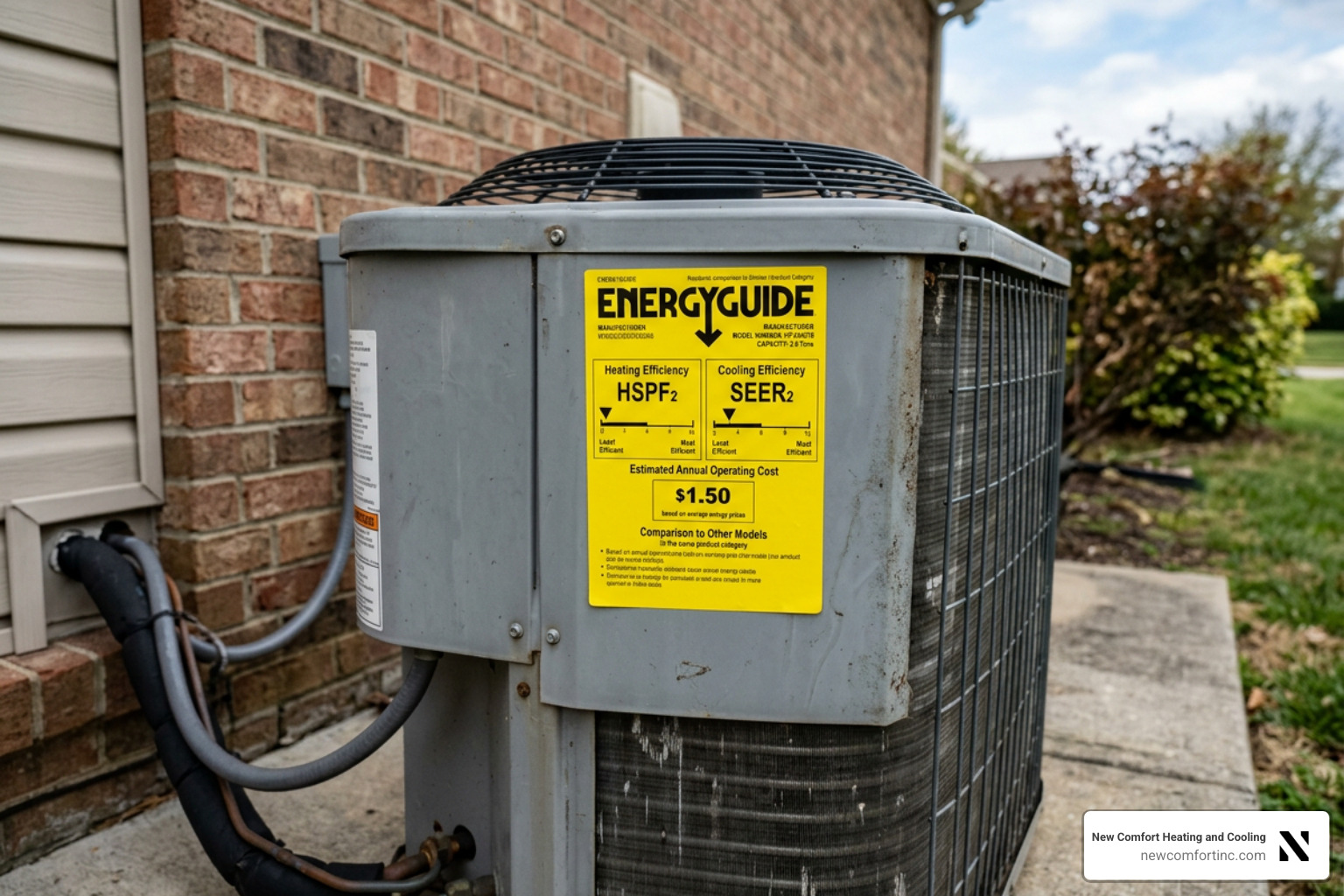
When you look at the bright yellow EnergyGuide label on a modern heating system, the heating seasonal performance factor tells you how much thermal comfort you get for every unit of electricity you purchase. Unlike standard electric baseboards or gas furnaces, heat pumps do not generate heat from scratch through combustion or direct resistance. Instead, they operate like a refrigerator in reverse, gathering ambient thermal energy from outside air and moving it into your living spaces.
Because moving heat requires far less electricity than creating it, modern heat pumps achieve seasonal efficiencies well beyond 100%. The rating provides a single standardized metric representing this thermodynamic work across an entire heating season. The testing framework uses Department of Energy (DOE) Region IV climate standards—a moderate mid-latitude profile—to establish an even playing field for comparing equipment.
The Mathematical Formula Behind Heating Efficiency
At its core, the rating represents a straightforward ratio:
Total Seasonal Heating Output (in British Thermal Units or BTUs) ÷ Total Electrical Energy Consumed (in Watt-hours or Wh)
For example, if a system delivers 60,000,000 BTUs of warmth over the winter while consuming 6,000 kilowatt-hours (6,000,000 Watt-hours) of electricity, its rating is exactly 10.0.
Because one Watt-hour equals approximately 3.412 BTUs, you can convert this seasonal metric into a dimensionless energy multiplier—also known as the seasonal Coefficient of Performance (COP) or Seasonal Performance Factor (SPF)—by multiplying the rating by 0.293 (or dividing by 3.412). A rating of 9.7 means the system delivers 2.84 times more thermal energy to your home than the electrical energy it draws from the grid. Investing in a next generation heat pump lets you capture these high thermodynamic multipliers, keeping your monthly utility consumption under control.
HSPF vs. HSPF2: What the Regulatory Shift Means
If you are comparing an older specification sheet to a new system installed today in August 2026, you will notice that the numbers on new equipment look lower. This change is the result of the Department of Energy updating its official testing procedures under Appendix M1.
Under the legacy testing standard (Appendix M), systems were evaluated against an external static pressure of roughly 0.1 to 0.2 inches of water column (in. w.c.). This laboratory condition failed to account for the real-world friction and resistance air encounters when traveling through tight duct transitions, filters, and supply registers. The updated Appendix M1 protocol increases standard testing static pressure to 0.5 in. w.c., presenting a realistic test of the blower fan motor.
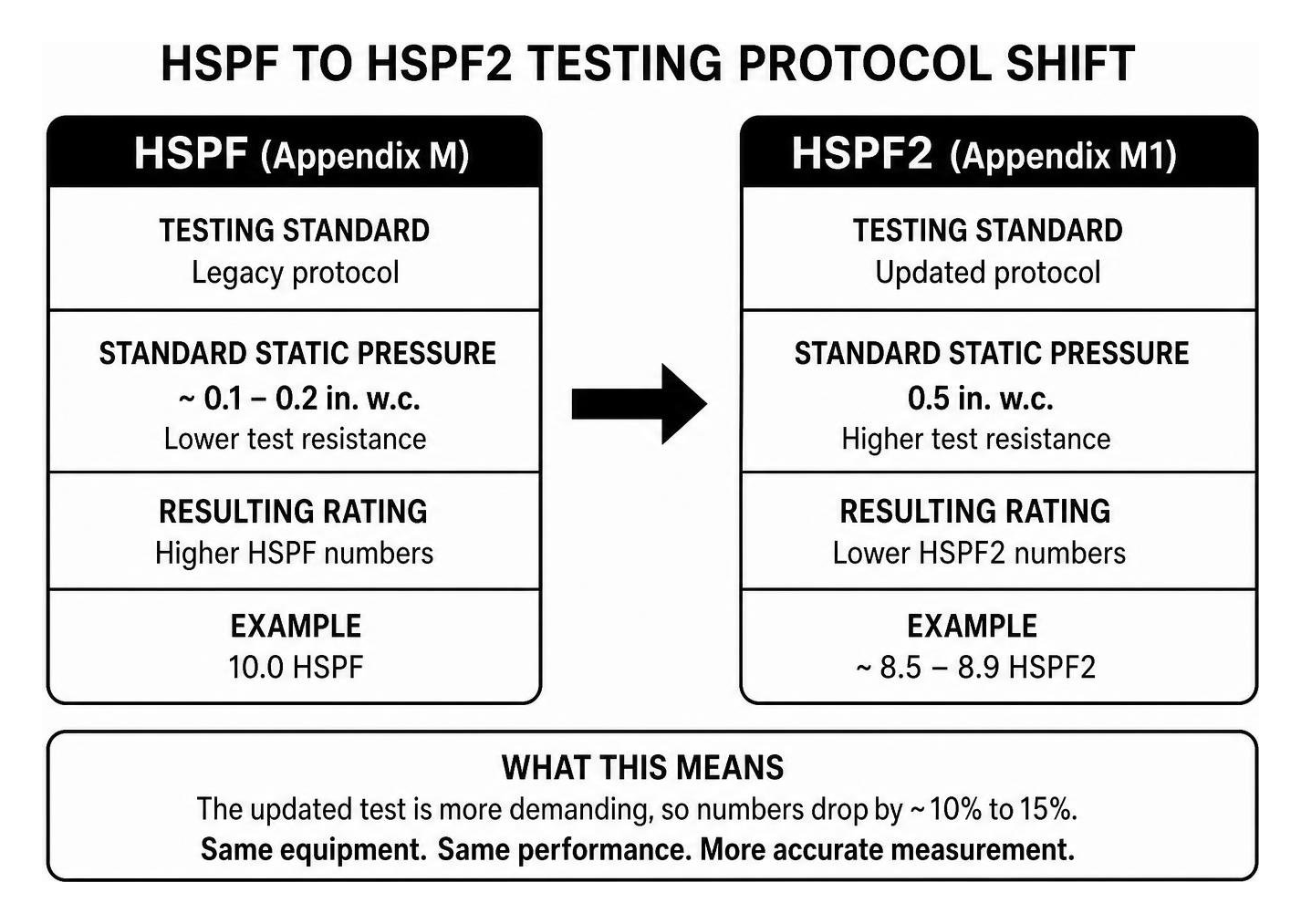
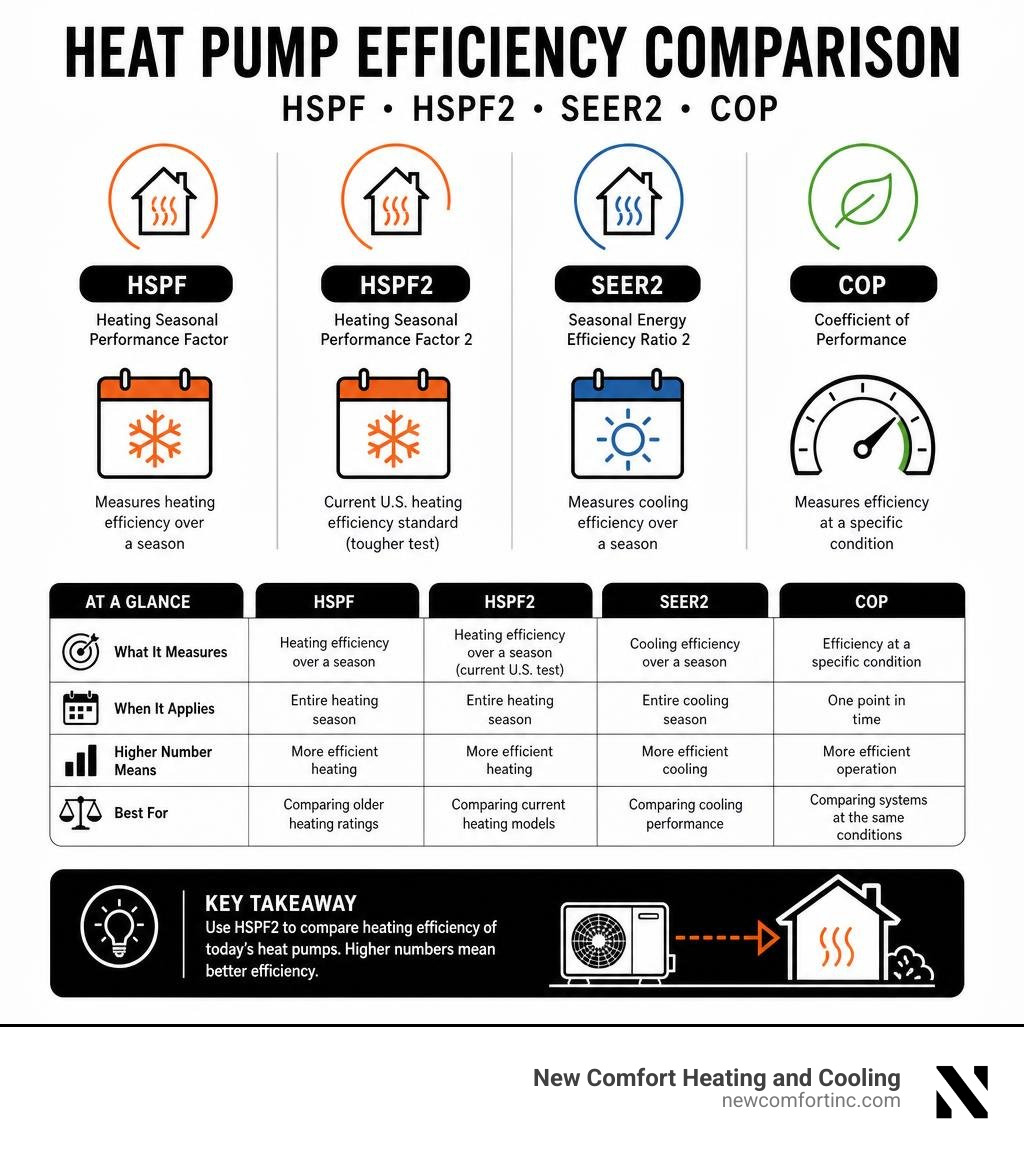
Because the updated test is more demanding, the resulting numeric score drops by roughly 10% to 15% for the exact same physical equipment. An older unit certified at 10.0 HSPF achieves approximately an 8.5 to 8.9 under HSPF2 testing. The equipment is just as capable and efficient; the measuring tape has simply become more accurate.
Comparing Heating and Cooling Efficiency Metrics
Choosing a climate-control system means sorting through a collection of HVAC acronyms. Heat pumps handle year-round comfort, requiring separate metrics for heating and cooling cycles.
| Metric | Primary Season | What It Measures | Minimum Standard | High-Efficiency Tier |
|---|---|---|---|---|
| HSPF | Heating (Winter) | Seasonal heating BTUs per Watt-hour (Legacy test) | 8.2 (Historical) | 10.0+ |
| HSPF2 | Heating (Winter) | Seasonal heating BTUs per Watt-hour (Appendix M1) | 7.5 (Split) / 6.7 (Packaged) | 8.5 to 10.0+ |
| COP | Heating (Steady-State) | Instantaneous energy output ÷ energy input | 1.0 (Electric resistance) | 3.0 to 4.0+ (at 47°F) |
| SEER2 | Cooling (Summer) | Seasonal cooling BTUs per Watt-hour | 13.4 (North) / 14.3 (South) | 16.0 to 20.0+ |
| EER2 | Cooling (Peak Heat) | Instantaneous cooling efficiency at steady 95°F | 10.0 to 11.0 | 12.0+ |
How to Compare Your Heat Pump HSPF Rating to COP and SEER2
While seasonal factors measure integrated operational performance over months of fluctuating weather, the Coefficient of Performance (COP) measures real-time efficiency at specific temperatures (such as 47°F, 17°F, or 5°F). COP serves as a direct indicator of instantaneous power: a COP of 3.0 means you receive 3 kW of heat output for every 1 kW of electric power input.
Cooling efficiency is tracked through Seasonal Energy Efficiency Ratio 2 (SEER2). In warm, southern states, homeowners focus on high SEER2 ratings because cooling dominates their electric bills. In northern areas like Illinois, winter heating accounts for the vast majority of annual energy use. Selecting equipment with matched seasonal ratings ensures balanced performance through changing Midwestern seasons, supported by dedicated HVAC heating services to fine-tune system balance.
The Difference Between Heating Metrics and Electric Resistance Heat
To see how efficient heat pumps are, compare them to standard electric resistance heating elements found in space heaters, electric furnaces, and backup heating strips.
Electric resistance heating turns 100% of its electrical input into heat, which gives it a COP of exactly 1.0. Converted to a seasonal rating scale, direct electric heat has an equivalent score of only 3.41 (calculated as 1.0 × 3.412).
When outdoor temperatures drop and standard heat pumps lose capacity, systems often engage supplemental electric resistance coils. Because backup heat strips run at that baseline 3.41 rating, excessive auxiliary run-time can increase your electric bill. Understanding the emergency heat switch on heat pumps helps prevent backup strips from running when your outdoor compressor can still heat your home efficiently.
Choosing the Ideal Heat Pump Efficiency for Your Climate

Regional weather dictates how much efficiency you need. In moderate climates with low heating degree days, entry-level models provide dependable comfort. In cold northern zones like the Chicago metro area, where winters bring long stretches of sub-freezing days, higher heating efficiency delivers noticeable energy savings. For homeowners in communities needing heating and cooling Clarendon Hills IL, choosing equipment with strong cold-weather performance keeps the home warm without unnecessary spikes in winter utility bills.
Every 1-point increase in heating efficiency reduces seasonal heating energy usage by roughly 5% to 7%. Moving from an older baseline unit to an advanced cold-climate system can trim several hundred dollars off your winter energy costs while delivering steadier indoor temperatures.
What Makes a Good Heat Pump HSPF Rating for Cold Climates?
In cold regions, a good rating starts at 8.5 HSPF2, with premium cold-climate units reaching 9.5 to 10.5+ HSPF2.
Because standard seasonal ratings are calculated using Region IV (moderate climate) data, looking at the seasonal score alone does not tell the whole story for sub-freezing weather. Reliable winter comfort requires evaluating low-ambient performance metrics outlined in the DOE cold climate specifications, including:
- Low-Ambient COP at 5°F: The unit must maintain a COP of at least 1.75 at 5°F outdoor temperature, ensuring it delivers nearly double the efficiency of electric resistance strips during freezes.
- Capacity Retention at 5°F: The system should deliver at least 70% to 80% of its nominal 47°F heating capacity when outdoor conditions plunge to 5°F.
- Variable-Speed Inverter Compressors: Modulating inverter drives adjust motor speeds in single-digit increments. This prevents on-and-off cycling, preserves capacity in freezing weather, and reduces mechanical wear.
Federal Standards and ENERGY STAR Guidelines
Federal regulations establish clear efficiency baselines across North America. The current minimum requirements under Appendix M1 include:
- Split-System Heat Pumps: Minimum 7.5 HSPF2 and 14.3 SEER2 (North) / 15.2 SEER2 (South).
- Single-Packaged Heat Pumps: Minimum 6.7 HSPF2 and 13.4 SEER2.
To earn certification under the latest ENERGY STAR heat pump criteria, split systems must achieve at least 7.8 HSPF2, 15.2 SEER2, and 11.0 EER2. Dedicated cold-climate ENERGY STAR models must reach a minimum of 8.1 HSPF2 for ducted systems (8.5 HSPF2 for ductless mini-splits), alongside verified heating performance at 5°F. Choosing ENERGY STAR-qualified equipment also helps homeowners take advantage of federal clean-energy tax credits and local utility rebates.
Real-World Factors That Impact Operational Heating Performance
A high efficiency rating on paper does not guarantee low operating costs if the equipment is installed incorrectly. Laboratory ratings assume ideal airflow, clean coils, airtight ductwork, and properly sealed living spaces. Real-world conditions can lower operational efficiency by up to 30% if key installation variables are neglected.
Equipment Sizing, Ductwork, and Whole-Home Insulation
Achieving rated performance depends on proper system design and a well-sealed building envelope:
- Accurate Manual J Load Calculations: Oversized heat pumps turn on and off rapidly in short cycles, wearing out internal components and reducing seasonal efficiency. Undersized units run continuously without reaching thermostat setpoints, forcing expensive auxiliary heat to turn on.
- Duct Integrity and Airflow: Leaky, uninsulated ducts in unconditioned attics or crawlspaces can lose 20% or more of the thermal energy produced by the system. Maintaining low static pressure ensures proper heat transfer across the indoor coil. Adding an engineered zoning system directs conditioned air where needed, reducing waste in unoccupied rooms.
- Envelope Insulation and Air Sealing: Upgrading attic insulation to recommended R-values (R-38 to R-49) and sealing air leaks around doors and windows reduces the home's overall heating load, allowing the heat pump to run at lower, more efficient speeds.
Dual-Fuel Integration and Hybrid Systems
For homes in the Chicago area facing sub-zero winter temperatures, a dual-fuel hybrid system offers a practical and reliable approach to home comfort.
A hybrid setup pairs an electric heat pump with a high-efficiency gas furnace. During mild winter and shoulder-season days (temperatures above 25°F to 30°F), the heat pump handles the heating load at peak efficiency. When outdoor temperatures plunge into extreme sub-zero digits, the smart thermostat automatically switches heating duties to the gas furnace. If you are already planning a furnace replacement, combining a new gas furnace with an electric heat pump provides reliable comfort through severe Midwestern cold snaps while trimming electricity demand.
Frequently Asked Questions About Heat Pump Ratings
Can you convert an old HSPF rating to a new HSPF2 rating?
Yes, you can approximate the conversion using a general rule of thumb. Because the Appendix M1 testing standard introduces higher external static pressure, HSPF2 ratings are roughly 10% to 15% lower than legacy ratings.
To estimate an HSPF2 rating from an older number, multiply the legacy rating by 0.85 (for example, a 10.0 HSPF system is approximately 8.5 HSPF2). To convert in the opposite direction, divide the HSPF2 value by 0.85. That this calculation is an estimate, as variable fan motors and cabinet geometries respond differently to static pressure increases.
Why does heat pump efficiency decrease during freezing outdoor weather?
Heat pumps extract heat from the outside air. As ambient temperatures drop, outdoor air contains less sensible heat energy, and the temperature difference between outdoor air and the circulating refrigerant narrows. This forces the compressor to work harder and consume more power to extract the same amount of heat.
Additionally, moisture on the outdoor coil can freeze in cold weather. The system must periodically enter a brief defrost cycle to melt frost buildup, temporarily reversing operation and reducing net seasonal efficiency.
Are higher efficiency ratings worth the investment for moderate climates?
In regions with short, mild winters and low heating degree days, top-tier heating ratings yield smaller annual utility savings than they do in cold climates. Homeowners in moderate zones often find their best value in mid-range systems (around 7.8 to 8.5 HSPF2), balancing upfront equipment investment against manageable seasonal operating costs. In colder northern climates, however, the longer heating season makes high-efficiency systems a smarter long-term choice.
Conclusion
Understanding your heat pump's seasonal efficiency rating is key to lowering winter utility bills and maintaining steady indoor comfort. While federal standards and ENERGY STAR guidelines establish reliable baseline ratings, real-world efficiency depends on proper equipment sizing, tight ductwork, and professional installation.
If you are ready to explore high-efficiency heat pumps, dual-fuel hybrid systems, or comprehensive heating maintenance in Chicago, Justice, and nearby communities, reach out to our team at New Comfort Heating & Cooling. We provide personalized HVAC assessments, 24/7 live phone support, and same-day service to keep your home warm and energy-efficient all winter long.