The Complete Guide to Finding Duct Cleaning Services Near You
Complete HVAC System Restoration vs. Standard Duct Cleaning
Calling the process duct cleaning is a bit of a misnomer. Cleaning only the sheet metal tubes while leaving the rest of your heating and cooling setup untouched is like vacuuming only half of your living room floor—the moment the system turns on, lingering dust cross-contaminates the clean areas. True air quality restoration requires evaluating and servicing the complete HVAC system.
When dust, dander, and soot accumulate inside your home, they do not just settle in the supply ducts. They settle across every internal surface exposed to the airstream. If a service provider vacuums out your return registers but neglects the air handling unit (AHU), the blower motor, or the indoor evaporator coils, the very first time your furnace or air conditioner kicks on, those dirty components will blow contaminants back into your newly cleaned ductwork.
A thorough system restoration ensures every single component listed below is inspected and cleaned:
- Heating and cooling coils (evaporator and condenser coils)
- Drain pans and condensate drain lines
- Supply and return air plenums
- Blower motor housing and fan blades
- Heat exchanger surfaces
- Registers, grilles, and diffusers
- Internal air duct surfaces
Skipping even one of these parts leaves a reservoir of debris inside the equipment, increasing the risk of mechanical issues down the road. Homeowners looking to prevent unexpected breakdowns can review our breakdown on the most common HVAC system failures and how to avoid them.
Mechanical Agitation and Contaminant Collection
Removing stubborn, caked-on dust from ductwork requires more than just high-powered suction. According to strict industry standards, effective HVAC decontamination relies on a two-step process: mechanical agitation to break debris loose, and continuous negative pressure to collect it.
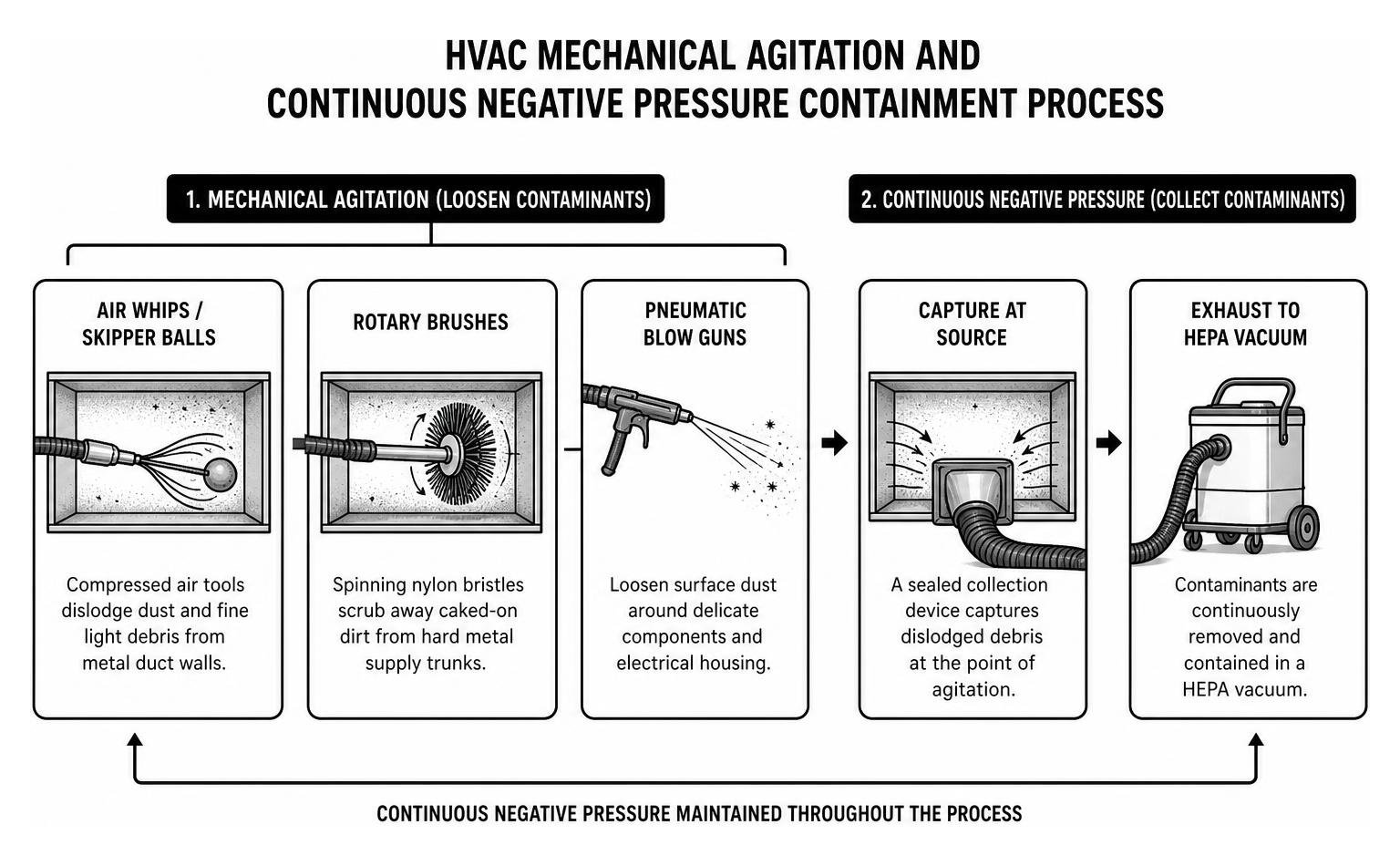
To dislodge debris, technicians use specialized tools tailored to your ductwork's material:
- Air Whips and Skipper Balls: Driven by compressed air, these high-velocity tools dislodge dust and fine light debris (such as cotton lint) from metal duct walls.
- Rotary Brushes: Soft nylon bristles spin inside hard metal supply trunks to scrub away caked-on dirt without damaging internal surfaces.
- Pneumatic Blow Guns: Used around delicate electrical housing, blower motors, and heat exchangers to loosen surface dust.
Once loose, these particles must be captured instantly so they do not blow into your living room.
Negative Pressure and Engineering Controls
To prevent cross-contamination during cleaning, the HVAC system must be placed under continuous negative pressure using powerful, commercial-grade vacuum collection equipment. This creates a powerful airflow vortex inside the ductwork, pulling all dislodged dust directly into the containment unit.
When portable vacuum equipment exhausts inside the home, it must be equipped with High-Efficiency Particulate Air (HEPA) filtration. These filters are engineered to achieve a minimum collection efficiency of 99.97% at a 0.3-micron particle size, capturing microscopic dust mites, pet dander, and fine powders.
During this process, technicians implement strict environmental engineering controls:
- Containment Barriers: Sealing supply and return registers with temporary plastic film maintains maximum static pressure and prevents dust escaping into occupied rooms.
- Isolation Dampers: Separating duct zones ensures high air velocity throughout the section being cleaned.
- Standard Compliance: Following rigorous procedural rules established in THE NADCA Standard (ACR) guarantees the system is restored without polluting indoor living spaces.
When to Inspect and Clean Your Heating and Cooling System
Routine, scheduled duct cleaning every few months is unnecessary. Instead, system cleaning should be performed on an as-needed basis when visual inspections reveal specific contamination triggers.
National standards established by the National Air Duct Cleaners Association (NADCA) outline clear inspection schedules for residential properties. While your air handling unit should be inspected visually every 1 year, your supply and return ducts require visual evaluation every 2 years.
If you are experiencing inconsistent airflow or persistent indoor air concerns, exploring our full range of Indoor Air Quality Solutions can help identify underlying ventilation issues.
| Condition / Trigger | Routine Standard | Action Required |
|---|---|---|
| Air Handling Unit (AHU) | Inspect every 1 year | Visual inspection of blower motor, coils, and drain pan. |
| Supply & Return Ducts | Inspect every 2 years | Check access points and registers for particulate buildup. |
| Visible Mold Growth | As-needed trigger | Immediate remediation and source-water leak repair. |
| Vermin / Pest Infestation | As-needed trigger | Immediate cleaning, vector removal, and duct sealing. |
| Post-Renovation Dust | As-needed trigger | Clean system if registers were unsealed during construction. |
| Visible Debris Discharge | As-needed trigger | Mechanical cleaning under continuous negative pressure. |
System Inspection Intervals and Contamination Triggers
Homeowners should consider scheduling an inspection and cleaning when any of the following specific conditions occur in their Justice or Chicago home:
- Substantial Visible Mold Growth: If you spot visible mold inside your hard metal supply ducts or on the air handler, intervention is necessary. However, many dark substances resemble mold. For a nominal fee, an independent microbiology laboratory can analyze a clear tape sample to confirm whether a substance is actual mold before you invest in extensive cleaning.
- Vermin Infestation: If rodents, insects, or birds have nested inside your ductwork, they leave behind droppings, dander, and foul odors that circulate whenever air flows.
- Heavy Dust or Debris Clogging: When air ducts become packed with excessive amounts of dust and debris, fine particles can actively discharge through your supply registers into living areas.
- Post-Construction Contamination: Remodeling work generates microscopic drywall dust, wood sawdust, and masonry grit. If your HVAC system ran while construction took place without sealed registers, that heavy grit settles inside your return trunks.
Preventing Future Air System Contamination
The most effective way to maintain clean air ducts is to prevent contaminants from entering the system in the first place:
- Use High-Efficiency Air Filters: Install air filters with a high MERV rating recommended by your unit's manufacturer. Ensure the filter fits tightly without gaps around the frame.
- Change Filters Regularly: Replace filters as soon as they become dirty. To understand how filter maintenance protects system hardware, check out The Ultimate Guide to Filter Replacement for Furnace Longevity.
- Seal Registers During Renovations: Always shut down your HVAC system and cover supply and return vents with plastic sheeting before sanding drywall, painting, or doing major construction.
- Control Indoor Moisture: Fix plumbing leaks, maintain outdoor drainage, and keep cooling coils and condensate drain pans clean to avoid standing water and microbial growth.
HVAC Efficiency, Health Claims, and Chemical Biocide Risks
Marketing claims around duct cleaning can sometimes be misleading. It is important to separate verified engineering facts from unproven sales pitches.

System Efficiency vs. Health Impacts
Despite what some promotional flyers claim, cleaning only the sheet metal air ducts has never been conclusively proven to prevent health problems or dramatically lower indoor dust levels. This is because much of the settled dust in ductwork sticks firmly to metal surfaces and does not automatically blow into living spaces.
However, cleaning dirty operational components—specifically the evaporator coils, heat exchanger, blower fan blades, and drain pans—has a direct, proven impact on your energy bills:
- Heat Exchange Efficiency: A thin layer of dust on an air conditioning coil acts as an insulator, reducing its heat-transfer capacity. Cleaning contaminated coils restores proper refrigerant pressure and cooling performance.
- Blower Fan Speed: Dust accumulation on fan blades distorts their curve, reducing airflow velocity and forcing the blower motor to run longer to satisfy your thermostat.
- Energy Savings: Restoring proper air velocity (which standard duct designs mandate at 2,500 to 3,000 feet per minute for light dust, and upwards of 4,500 feet per minute for heavy dust) reduces overall system runtime.
For detailed strategies on cutting monthly energy expenses across Northern Illinois homes, read our expert guide on HVAC Maintenance Lower Energy Bills Chicago. Homeowners can also review official guidelines directly in the EPA Guide on Duct Cleaning.
Biocides, Encapsulants, and Chemical Safety
A major area of concern in the indoor air quality industry involves the improper use of chemical biocides, disinfectants, and duct encapsulants (sealants).
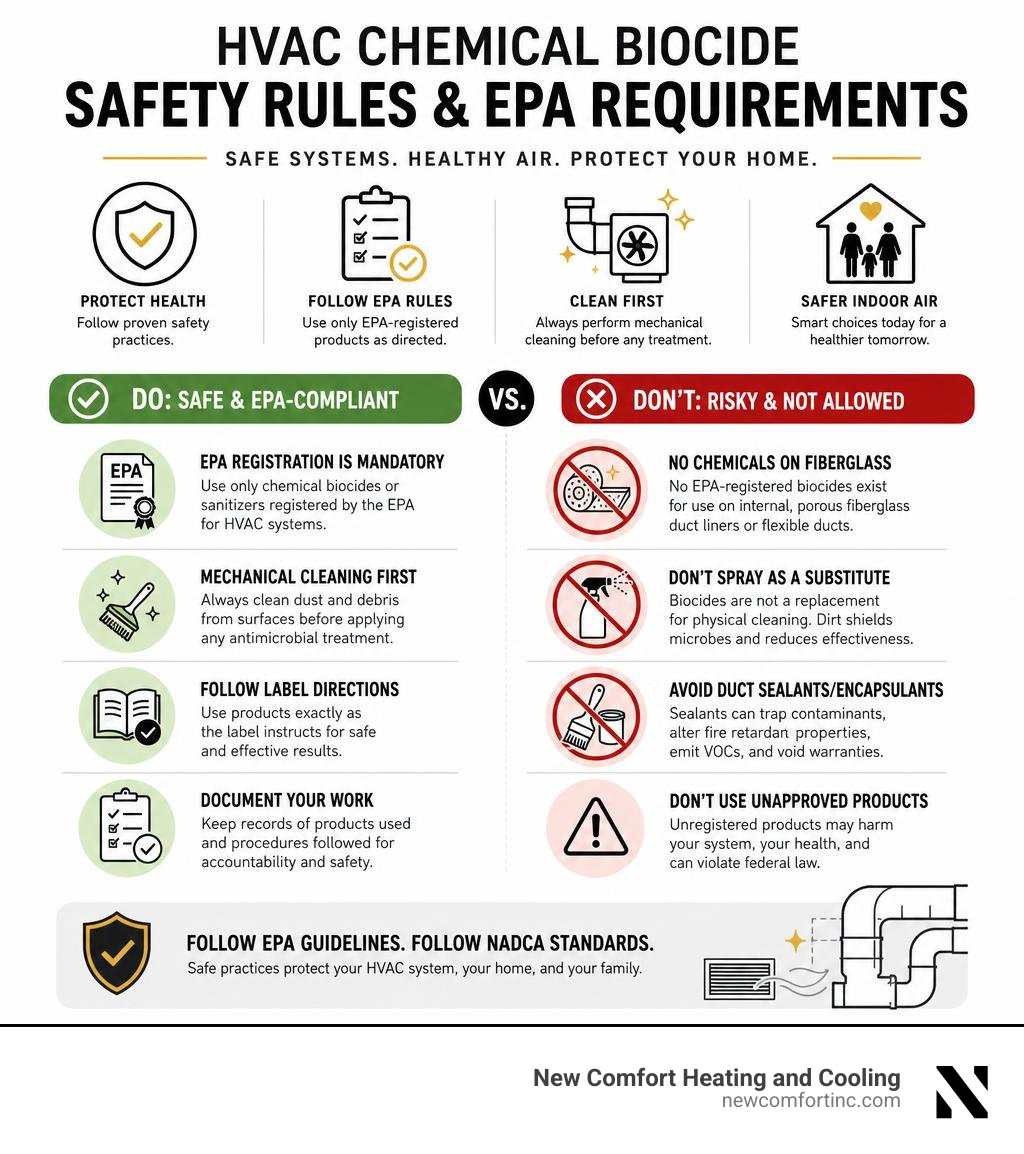
Homeowners should keep the following guidelines in mind regarding chemical treatments:
- EPA Registration is Mandatory: Chemical biocides or sanitizers applied to any HVAC component must be explicitly registered with the U.S. Environmental Protection Agency (EPA) for use inside heating and cooling systems.
- No Chemical Use on Fiberglass: Currently, there are no chemical biocides registered by the EPA for use on internal, porous fiberglass duct liners or flexible ductwork. If porous duct insulation becomes wet or mold-contaminated, it cannot be cleaned or disinfected—it must be completely removed and replaced.
- Mechanical Cleaning First: Biocides should never be sprayed as a substitute for physical cleaning. NADCA standards state that mechanical surface cleaning must always precede any antimicrobial treatment.
- Sealant Risks: Applying chemical sealants or encapsulants inside air ducts to "cover up" dust is an unproven practice that can alter the fire retardant properties of your ductwork, emit VOC odors, and potentially void equipment warranties.
Selecting Qualified HVAC Service Providers
Finding a qualified contractor requires careful research and clear questions. Avoiding low-cost "blow-and-go" scams protects your home, your heating and cooling equipment, and your wallet.

Evaluating Credentials for Duct Cleaning Contractors
When selecting a service provider in the Chicago area, look for verified credentials and professional standards:
- NADCA Certification: Ensure the company employs certified Air Systems Cleaning Specialists (ASCS) or Certified Ventilation Inspectors (CVI). These credentials certify that technicians understand HVAC engineering, air dynamics, and decontamination standards.
- Written Work Plan: A reliable contractor creates a detailed, written scope of work before starting. This plan outlines access point locations, mechanical agitation tools, engineering containment controls, and Safety Data Sheets (SDS) for any products used.
- Complete System Scope: Confirm in writing that the company will clean all system components—including the blower motor, heat exchanger, evaporator coils, and plenums—rather than just vacuuming floor registers.
- Consumer Protection: Avoid door-to-door solicitation or contractors claiming to be "certified by the EPA." The EPA does not certify, endorse, or approve individual duct cleaning businesses.
Verifying Results After Duct Cleaning Services
Once the service is complete, perform a thorough post-cleaning evaluation before signing off:
- Visual Inspection: Use a flashlight and a small mirror (or your smartphone camera) to inspect supply trunks, return plenums, and coil fins. Surfaces should be free of visible dust, debris, and oil coatings.
- Access Hole Craftsmanship: If technicians cut service panels into your sheet metal trunks to reach hidden sections, check how those holes were closed. Service panels must be mechanically fastened with metal screws or rivets at a minimum of 4 inches on center.
- UL 723 Standards: Materials used to seal service openings must comply with UL 723 standards, maintaining a flame-spread rating under 25 and a smoke-developed rating under 50.
- Post-Cleaning Checklist: Verify that the air handling unit door is securely fastened, the condensate line flows freely, and your system's air filter is clean and properly seated.
What to Expect on Duct Cleaning Day
Knowing how a professional visit should unfold makes it easier to spot a thorough job and avoid a rushed one. While every home is different, a complete duct cleaning appointment generally follows a predictable sequence.
- Pre-Cleaning Inspection: The technician examines the air handler, coils, blower, and accessible air ducts, often with a camera, and explains what was found before work begins.
- Protecting Your Home: Floors near the equipment and work areas are covered, and supply and return registers are sealed to keep dislodged debris out of living spaces.
- Connecting the Collection Equipment: A high-powered vacuum unit is attached to the system to create continuous negative pressure.
- Agitation and Cleaning: Brushes, air whips, and hand tools work through each branch line and trunk while the vacuum pulls debris away.
- Component Cleaning: The blower assembly, coils, drain pan, and plenums are cleaned as part of the system scope.
- Final Walkthrough: Access openings are sealed, a fresh filter is installed, the system is restarted, and you are shown the results.
Expect the work to take several hours for a typical single-family home, longer for larger homes, multiple systems, or heavily contaminated ductwork. Clearing furniture away from registers and the furnace area before the crew arrives helps the day run smoothly.
Questions to Ask Before Booking Duct Cleaning Services
Comparing duct cleaning services by price alone is risky, since unusually low offers often signal a quick vacuum of the registers instead of a full system cleaning. Before you book, ask each company:
- Will you inspect the system first and show me evidence of contamination?
- Which components are included: ducts only, or also the blower, coils, drain pan, and plenums?
- What equipment do you use to create negative pressure, and how is exhaust filtered?
- Do you follow NADCA's ACR standard, and are your technicians certified?
- Do you plan to apply any chemical treatments, and if so, are they EPA-registered for HVAC use?
- How will access openings be sealed, and what does the final price include?
The National Air Duct Cleaners Association (NADCA) maintains information on industry standards and certified professionals that can help you evaluate your options.
Duct Cleaning Considerations for Chicago-Area Homes
Homes across Chicago's western and southwest suburbs present a few common situations worth keeping in mind. Many houses have ductwork running through unfinished basements, where humidity in summer can encourage moisture and microbial growth on nearby surfaces. Older homes may have decades of accumulated debris in return ducts, and recently renovated homes often hold drywall dust in the system.
Because furnaces run for long stretches during winter, a dirty blower or coil has more opportunity to spread dust and lose efficiency. Pairing an inspection with your seasonal HVAC system tune-up is a practical way to decide whether duct cleaning is actually needed. To talk through your home's indoor air quality concerns, call New Comfort Heating and Cooling at (708) 717-9995.
Frequently Asked Questions About System Maintenance
How often should residential air ducts be inspected?
According to NADCA ACR standards, residential air handling units (AHUs) should be inspected visually once every 1 year. The supply and return duct trunks should be inspected at least once every 2 years. Routine cleaning is only required if these visual checks uncover excessive dust, mold, or pest activity. For more everyday maintenance answers, browse our full HVAC FAQ and general company FAQ.
Does cleaning air ducts remove mold permanently?
Cleaning removes existing microbial growth from non-porous metal duct surfaces, but it will not keep mold from returning if moisture remains. Mold requires water to grow. Any underlying plumbing leaks, coil condensation drain clogs, or high indoor humidity issues must be permanently repaired. If internal porous insulation or flex duct gets contaminated by mold, it cannot be thoroughly disinfected and must be replaced.
How do service technicians access hidden duct interiors?
Technicians first utilize existing openings like return grilles, supply registers, and removable equipment access panels. When internal duct sections are unreachable with agitation tools, professionals carefully cut dedicated service access openings into the sheet metal. After cleaning, these openings are covered with heavy-gauge metal patch plates, mechanically fastened with screws every 4 inches, and sealed airtight with mastic tape.
Conclusion
A clean, balanced HVAC system is essential for a comfortable and efficient home. When done properly, duct cleaning removes trapped construction debris, clears out severe dust buildup, and restores peak airflow across your heating and cooling components. By insisting on continuous negative pressure containment, thorough mechanical agitation, and certified technicians, you ensure your system gets a safe, standard-compliant restoration.
At New Comfort Heating and Cooling, our team brings live support, transparent pricing, and personalized solutions to homeowners across Justice, Chicago, and surrounding communities. Whether you need a full ventilation audit, routine seasonal maintenance, or targeted indoor air quality upgrades, visit our Indoor Air Quality Services to schedule your consultation today.