The Homeowner Quick Guide to Finding Reliable 24-Hour Water Heater Services
Find Reliable 24 Hour Water Heater Repair Near Me Fast
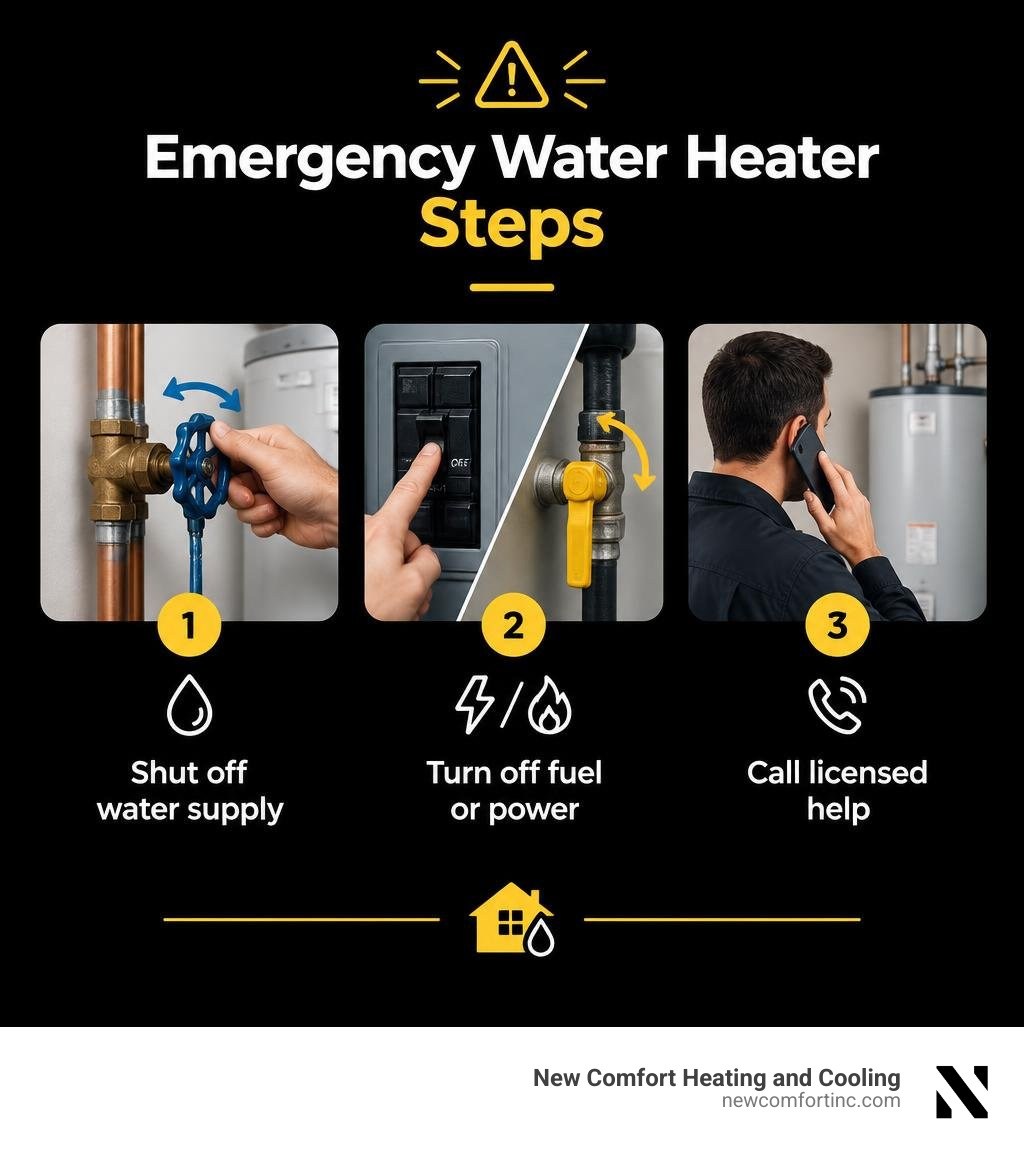
For 24 hour water heater repair near me, call a licensed, insured emergency technician as soon as you notice a leak, no hot water, a burst tank, or a gas smell. While you wait:
- Shut off the water supply to the heater if it is safe to reach.
- Turn off power at the breaker for an electric unit, or close the gas valve for a gas unit.
- Keep people away from pooling water and move valuables out of the area.
- Leave the home and call the gas utility or 911 if you smell gas.
A water heater failure can range from an inconvenient cold shower to a fast-moving water-damage risk. A small leak can waste more than 10 gallons per day, while a failed tank, electrical issue, or gas problem needs prompt professional attention.
The right emergency service should offer live dispatch, a clear arrival estimate, licensed technicians, and an upfront explanation of the repair options before work begins. This guide explains how to respond safely, choose a dependable local provider, and decide whether repair or replacement makes the most sense.
Terms related to 24 hour water heater repair near me:
Identifying Water Heater Emergencies and Immediate Action Steps
When a water heater malfunctions in the middle of the night, it rarely gives polite advance notice. Recognizing the severity of the problem is essential to protect your property and your family. Water heaters combine high water pressure, extreme temperatures, and either high-voltage electricity or combustible gas. When something goes wrong, the hazards escalate quickly.
Major issues include active water leaks, ruptured internal tanks, failing temperature and pressure relief (TPR) valves, electrical shorts, and gas leaks. A structural tank failure can quickly flood a basement, utility room, or living space with dozens of gallons of scalding water, leading to warped flooring, ruined drywall, and structural damage.
If you suspect an immediate hazard—especially a gas odor or an electrical issue coupled with standing water—it is critical to follow established emergency response protocols to stabilize your home safely before calling for professional help.

Signs You Need 24 Hour Water Heater Repair Near Me Immediately
Not every water heater quirk requires a midnight dispatch, but certain warning signs mean you cannot afford to wait until normal business hours. You should seek urgent professional assistance if you observe any of the following:
- Active Tank Leaks or Ruptures: Water pooling rapidly beneath the unit often signals that the inner tank has corroded and failed.
- Gas Odors: A smell resembling rotten eggs near a gas water heater indicates a hazardous gas leak. Vacate the premises immediately and contact your gas utility.
- Scorching, Popping, or Rumbling Sounds: Loud popping or banging sounds suggest severe sediment accumulation that is overheating the bottom of the tank, creating steam pockets and high pressure.
- Rusty or Discolored Hot Water: If only your hot water comes out brown, yellow, or metallic-smelling, the sacrificial anode rod has likely depleted, allowing the steel tank walls to rust from the inside out.
- Total Loss of Hot Water in Freezing Weather: A sudden loss of hot water during winter freezes can point to frozen supply lines or severe burner failure.
- Tripping Circuit Breakers: If an electric water heater repeatedly trips your main panel, a heating element has likely shorted against the water supply, creating a serious shock hazard.
Recognizing these red flags helps with knowing when to call a technician before minor leaks escalate into devastating structural damage.
Step-by-Step Emergency Response Before the Technician Arrives
Taking prompt, calculated action while our service team is on the way minimizes structural water damage and protects your home. Follow this sequence:
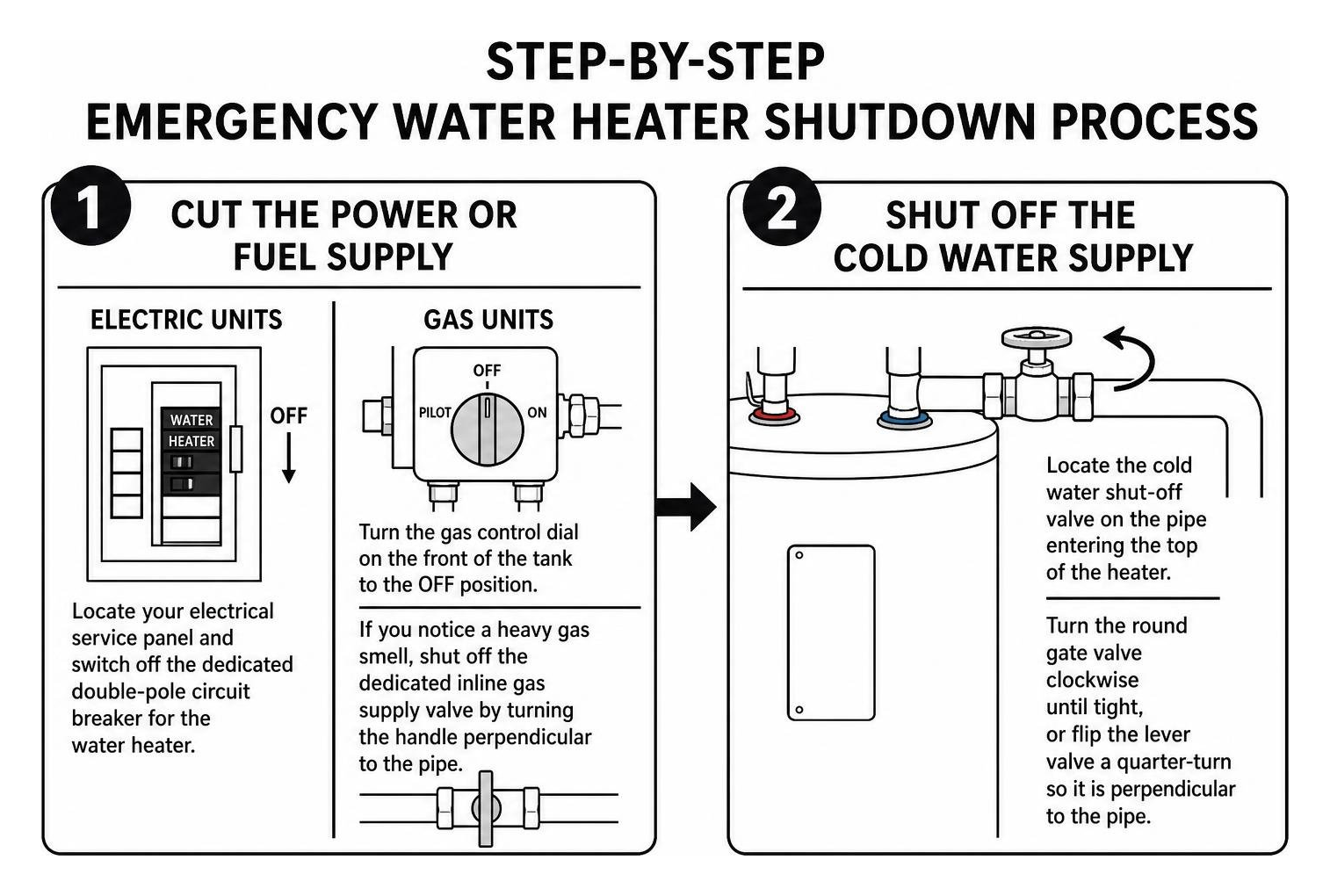
- Cut the Power or Fuel Supply:
- Electric Units: Locate your electrical service panel and switch off the dedicated double-pole circuit breaker labeled for the water heater.
- Gas Units: Turn the gas control dial on the front of the tank to the "OFF" position. If you notice a heavy gas smell, shut off the dedicated inline gas supply valve on the gas pipe leading into the heater by turning the handle perpendicular to the pipe.
- Shut Off the Cold Water Supply:
- Locate the cold water shut-off valve on the pipe entering the top of the heater. Turn the round gate valve clockwise until tight, or flip the lever valve a quarter-turn so it is perpendicular to the pipe.
- If that valve is frozen, corroded, or inaccessible due to flooding, locate and close your home's main water shut-off valve.
- Relieve Internal Pressure (If Safe):
- Turn on a hot water faucet at the lowest level of your home (such as a basement utility sink or bathtub). This relieves built-up pressure inside the tank and prevents water from siphoning back through the lines.
- Mitigate Water Damage:
- If water is pooling on the floor, use a wet-dry vacuum, towels, or a portable sump pump to clear standing moisture.
- Move furniture, electronics, and stored personal items away from the perimeter of the heater to prevent moisture absorption and mold growth.
How to Choose the Best 24 Hour Water Heater Repair Near Me
When water is spreading across your floor, you might feel pressured to hire the first company listed online. However, taking a few minutes to confirm contractor credentials ensures you receive lasting repairs rather than temporary patches that violate local building codes.
Reliable emergency providers maintain 24/7 live dispatching, offer guaranteed response windows, carry comprehensive licensing and insurance, and arrive in fully equipped vehicles capable of resolving problems on the spot.
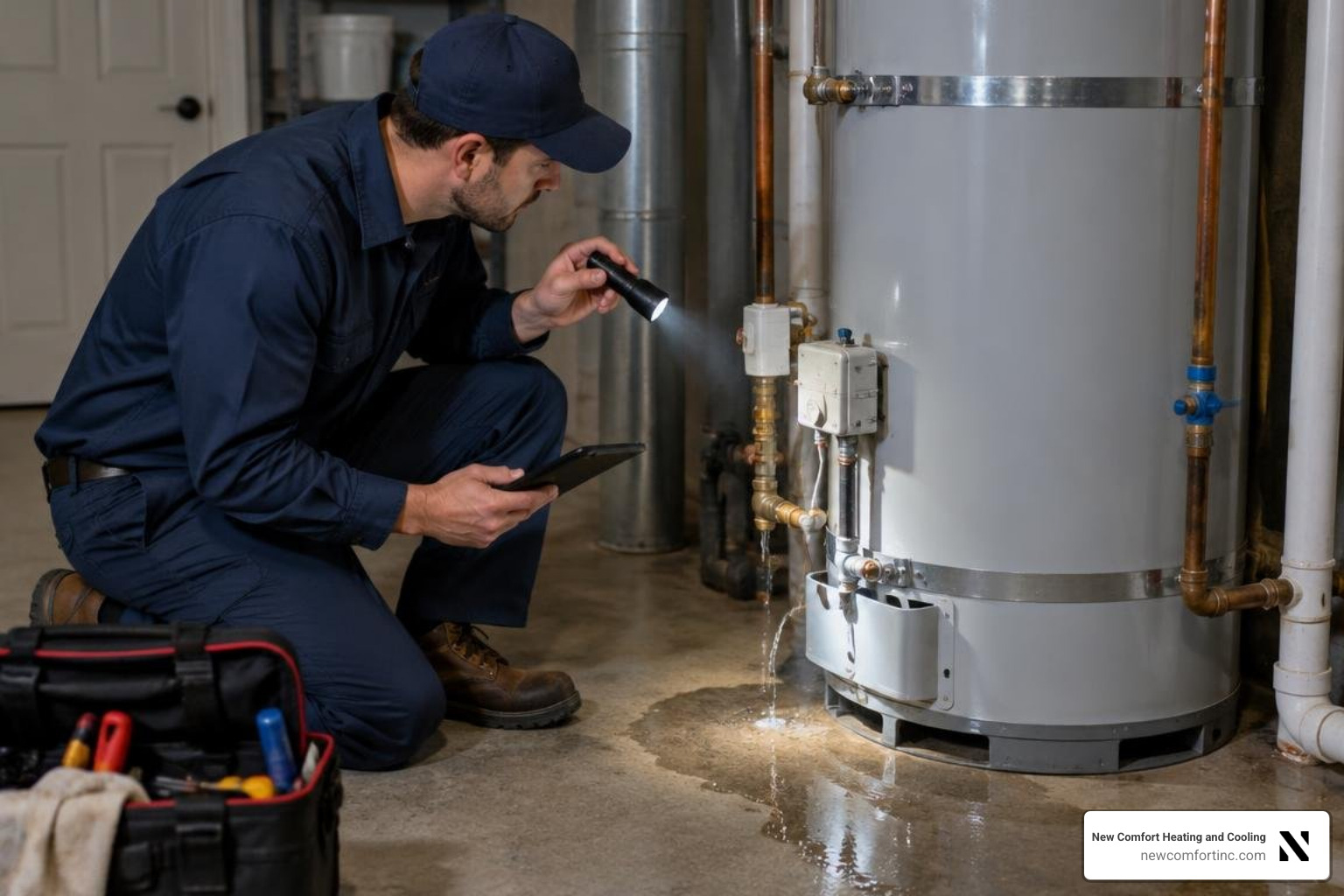
When evaluating providers in an urgent situation, following a clear framework for vetting emergency service providers will protect your home and prevent recurring breakdowns.
What to Expect When Calling 24 Hour Water Heater Repair Near Me
When you reach out to an emergency repair team, the dispatch process should be streamlined and reassuring. Knowing what to expect during emergency calls helps reduce stress during a home crisis:
- Live Intake and Triage: A professional dispatcher answers your call, asks targeted questions about your water heater's fuel source, age, and symptoms, and provides immediate safety guidance.
- Accurate Arrival Estimates: You receive an estimated time of arrival based on real-time traffic and technician availability, keeping you informed from start to finish.
- Comprehensive On-Site Diagnostics: Upon arrival, the technician inspects electrical components, gas valves, burner assemblies, thermostats, and tank integrity using professional diagnostic equipment.
- Clear, Upfront Options: Before any work starts, the technician explains the root cause and provides clear repair and replacement recommendations with transparent estimates.
- Fully Stocked Service Vehicles: Technicians arrive with common replacement components—such as universal thermostats, electric heating elements, thermocouples, gas control valves, and TPR valves—enabling immediate resolution without unnecessary delays.
Key Qualifications and Licensing Requirements
Never allow an unlicensed handyman to service complex water heating systems. Water heaters operate under intense pressure and utilize high-voltage electrical circuits or volatile fuel lines. Mistakes during repair or installation can lead to electrical fires, carbon monoxide leaks, or tank explosions.
Verify that your contractor holds valid municipal and state plumbing or HVAC licenses, carries comprehensive general liability insurance, and maintains active worker's compensation coverage. Reputable contractors adhere strictly to local plumbing codes, pull required municipal permits for full replacements, and back their workmanship with labor warranties. You can verify track records and community reputations by checking authentic feedback on local contractor directory reviews.
Water Heater Repair vs. Replacement: Making the Right Decision
One of the most common dilemmas homeowners face during an emergency call is deciding whether to repair a damaged unit or invest in a brand-new system. Making an informed choice requires assessing the unit's age, the location of the failure, and overall operating efficiency.
A helpful guideline is the 50 Percent Rule: if the unit has surpassed its expected service life and the total cost of the required repair approaches 50 percent of the cost of a new installation, replacing the unit is almost always the smarter long-term financial decision. For broader insight on managing aging home comfort systems, consider evaluating heating equipment longevity.
Evaluating Traditional Tank vs. Tankless Upgrades
If an emergency replacement is necessary, you will need to choose between a standard storage tank heater and a high-efficiency on-demand tankless unit. Both options offer distinct operational advantages:
| Feature / Metric | Traditional Storage Tank Heaters | On-Demand Tankless Water Heaters |
|---|---|---|
| Average Lifespan | 8 – 12 Years | Up to 20+ Years |
| Energy Efficiency | Standard baseline (constant standby heat loss) | Up to 34% more energy efficient |
| Hot Water Supply | Limited to tank capacity (e.g., 40–50 Gallons) | Continuous, endless hot water flow |
| Physical Footprint | Large floor footprint (approx. 15–20 sq. ft.) | Compact wall-mounted design |
| Emergency Replacement Ease | Direct swap with existing connections | May require gas line or venting upgrades |
| Maintenance Needs | Annual tank flushing & anode check | Annual heat exchanger descaling |
Traditional storage units remain popular for urgent replacements because they connect directly to existing venting, gas, or electrical lines with minimal modifications. However, tankless systems offer roughly double the operational lifespan, eliminate standby energy losses, and deliver endless hot water on demand.
Common Component Repairs vs. Complete Unit Failure
Understanding which parts can be serviced helps you evaluate a technician's recommendations:
- Repairable Component Failures:
- Faulty Thermocouple or Flame Sensor: Prevents the pilot light or gas burner from staying lit.
- Burned-Out Heating Elements: Causes lukewarm or completely cold water in electric systems.
- Failed Upper or Lower Thermostats: Causes erratic water temperature swings.
- Leaking Drain Valve or TPR Valve: Threaded valves that can be unscrewed and replaced quickly.
- Faulty Expansion Tank: External pressure bladders that can be swapped without replacing the heater.
- Non-Repairable Failures (Mandatory Replacement):
- Corroded Tank Body: Once rust eats through the steel inner jacket, the tank cannot be welded or sealed.
- Punctured Bottom Pan: Severe sediment buildup trapping heat until the base steel fatigues and splits.
Preventative Maintenance to Avoid Future Emergencies
Emergency repairs can be stressful. Fortunately, routine preventative maintenance can reduce emergency repair calls by up to 50% while helping your water heater run 10% to 15% more efficiently throughout its life.
Taking proper care of your water heater protects internal components, prevents sediment buildup, and ensures reliable hot water year-round. Integrating this care alongside routine heating system checkups provides peace of mind for all your primary home comfort equipment.
DIY Checks Homeowners Can Perform Safely
You can complete several simple, non-invasive maintenance tasks every few months to keep your system in good condition:
- Perform Visual Leak Inspections: Check around the base of the tank, water inlet connections, and shut-off valves for moisture, white mineral crusts, or rust streaks.
- Inspect the Pilot Flame (Gas Units): A healthy pilot flame burns a crisp, steady blue. A flickering yellow or orange flame indicates improper combustion, dirty burners, or inadequate airflow.
- Check Temperature Settings: Keep your water heater thermostat set at 120°F (49°C). This provides plenty of hot water while preventing accidental scalding and slowing mineral buildup inside the tank.
- Clear the Surrounding Area: Keep the perimeter around your water heater clean and clear of clutter, paints, solvents, and combustible materials to allow proper ventilation.
Professional Annual Servicing Benefits
While visual inspections help catch early warning signs, an annual tune-up by a licensed technician addresses hidden wear and tear:
- Full Tank Flushing and Sediment Removal: Over time, dissolved calcium and magnesium settle at the bottom of the tank, creating an insulating layer of rock. This causes the burner to overheat the tank base, leading to early failure. Flushing removes this accumulation.
- Sacrificial Anode Rod Inspection: The anode rod attracts corrosive elements in the water to protect the steel tank. Once this rod depletes completely, the tank itself begins to rust. Replacing the anode rod every few years significantly extends your heater's lifespan.
- Temperature and Pressure Relief (TPR) Valve Testing: Technicians test the TPR safety valve to confirm it will open properly if internal tank pressure exceeds safe thresholds.
- Electrical and Gas Safety Checks: Technicians check amp draws on electric heating elements, calibrate thermostats, inspect thermocouple wiring, clean gas burner orifices, and verify that venting systems are drafting combustion gases safely outdoors.
Winter Water Heater Emergencies in the Chicago Suburbs
Cold weather is hard on water heaters across Chicago's western and southwest suburbs. In January and February, incoming water from the main can be far colder than it is in summer, so the burner or heating elements must work longer to reach the same temperature. That extra run time exposes weak thermocouples, worn elements, and sediment-choked tanks, which is why so many calls for 24 hour hot water heater repair arrive during the coldest weeks of the year.
Basements and attached garages add their own risks. A water heater installed near an exterior wall or an unheated crawlspace can have supply lines that freeze overnight. Strong winds can also cause downdrafts in older atmospheric vents, blowing out the pilot light on a gas unit. If you lose hot water during a cold snap, check whether other fixtures still have cold water flow before assuming the tank itself has failed.
Preparing for an Emergency Before It Happens
A few minutes of preparation makes any after-hours call faster and safer:
- Label the Shut-Off Valves: Tag the cold water inlet valve, the gas shut-off, and the water heater breaker so anyone in the home can find them quickly.
- Keep a Clear Path: Make sure the area around the tank is free of boxes and stored items so a technician can work immediately.
- Install a Drain Pan and Leak Alarm: An inexpensive water sensor near the base of the tank can warn you of a slow leak before it reaches finished flooring.
- Write Down the Model and Age: The rating plate on the side of the tank lists the model, serial number, and capacity. Sharing these details when you call helps the technician bring the right parts.
- Save a Trusted Number: Searching for 24 hour water heater repair near me in the middle of a flood is stressful. Saving a local provider's number in advance lets you act right away.
How 24 Hour Hot Water Heater Service Differs From Regular Appointments
A standard appointment is scheduled around your calendar and the contractor's routing. A 24 hour hot water heater service call is triaged by urgency instead: active leaks, gas odors, and electrical hazards come first. Expect the technician to focus first on making the situation safe, then on restoring hot water, and finally on discussing longer-term options such as a full replacement.
After-hours visits may carry different rates than weekday appointments, so ask the dispatcher how pricing works before the technician is sent. A reputable provider will explain the diagnostic charge, give you options before starting work, and never pressure you into an immediate replacement unless the tank itself has failed. In many cases, emergency water heater repair simply stabilizes the system overnight so a planned replacement can be scheduled at a convenient time.
New Comfort Heating and Cooling, based in Justice, IL, has served homeowners in Chicago's western and southwest suburbs since 2013 and offers 24/7 emergency service. If you need help with a water heater outside normal hours, call (708) 717-9995 or visit our emergency service page.
Frequently Asked Questions About 24-Hour Water Heater Services
How quickly can an emergency technician arrive at my home?
Most dedicated 24-hour repair services dispatch technicians to arrive within 30 to 90 minutes of your call, depending on severe weather, road conditions, and technician proximity. Top-tier providers triage calls immediately so that hazardous situations—such as active indoor flooding or gas odors—receive priority dispatch.
Should I replace my leaking water heater with a tankless model during an emergency?
Upgrading to a tankless system during an emergency is certainly possible, but it depends on your current home infrastructure and timeline. Tankless units often require dedicated high-capacity gas lines, specialized PVC or stainless steel venting, and upgraded electrical circuits. If your home requires extensive retrofitting, a same-day direct replacement with a high-efficiency traditional storage tank heater may be the fastest way to restore hot water, while scheduled tankless conversions can be planned for a later date.
What brands and models do emergency technicians service?
Experienced emergency heating and plumbing contractors service all major residential and commercial water heater brands, including:
- A.O. Smith
- Rheem
- Bradford White
- Rinnai
- Navien
- State Water Heaters
- Bosch
- Lochinvar
- American Standard
Technicians carry universal diagnostic tools and versatile replacement parts to service standard atmospheric gas heaters, power-vent units, electric storage systems, hybrid heat pump water heaters, and commercial systems.
Is a leaking water heater an emergency?
It depends on where the water is coming from. A slow drip from the drain valve or a loose fitting can often wait for a scheduled visit once you place a pan beneath it. Water leaking from the tank body, a TPR valve that discharges repeatedly, or any leak combined with a gas smell or electrical hazard calls for emergency water heater repair right away.
Can I use hot water while waiting for 24 hour water heater repair near me?
If you have shut off the water supply and the fuel or power to the unit, do not use hot water until a technician has inspected it. Running fixtures can draw more water into a leaking tank or let a damaged tank refill and leak again. Cold water to the rest of the house can usually stay on if the leak is isolated at the heater's inlet valve.
Conclusion
A water heater failure does not have to turn into a household disaster. By taking immediate action—shutting down the water supply, cutting electrical power or gas lines, and reaching out to an experienced local team—you can protect your home from extensive water damage and restore hot water quickly.
Whether you need a late-night component repair or a same-day emergency replacement, working with a licensed, insured contractor ensures the job is completed safely, cleanly, and in full compliance with local building codes. Stay ahead of unexpected breakdowns by keeping up with routine inspections, flushing sediment regularly, and addressing minor warning signs before they turn into emergencies. Whenever you encounter system trouble, you can rely on our team to schedule professional heating services and keep your home safe, efficient, and comfortable around the clock.