Don't Sweat It: A Homeowner's Guide to AC Repair
When Your AC Breaks Down, You Need Answers Fast
AC repair HVAC problems can go from minor annoyance to full-blown emergency fast — especially during a Chicago summer when your family is counting on cool air.
Here's a quick overview of what homeowners need to know:
| Question | Quick Answer |
|---|---|
| How do I know I need AC repair? | Warm air, strange noises, high bills, ice on lines, or short cycling |
| How much does AC repair cost? | $85–$5,000 depending on the part; most common repairs run $350–$750 |
| Repair or replace? | If repair costs more than 50% of a new system and the unit is 10+ years old, replace it |
| How fast can I get service? | Same-day service is often available |
| What should I demand from a tech? | Written diagnosis, flat-rate pricing, and a parts-and-labor warranty |
The good news? Most AC breakdowns come down to a handful of fixable problems. Catching the warning signs early — before a small issue takes out an expensive component like the compressor — can save you thousands.
At New Comfort Heating and Cooling, we understand how confusing AC repair HVAC decisions can be for homeowners. In this guide, we'll walk you through everything you need to know — from spotting the first warning signs to understanding exactly what you'll pay.
How to Tell When You Need AC Repair HVAC Services
We have all been there: it is the middle of July 2026, the humidity in northern Illinois is through the roof, and you suddenly realize your home feels more like a sauna than a sanctuary. Your air conditioner is running, but something is clearly off. How do you know if you are facing a minor hiccup or a major system failure?

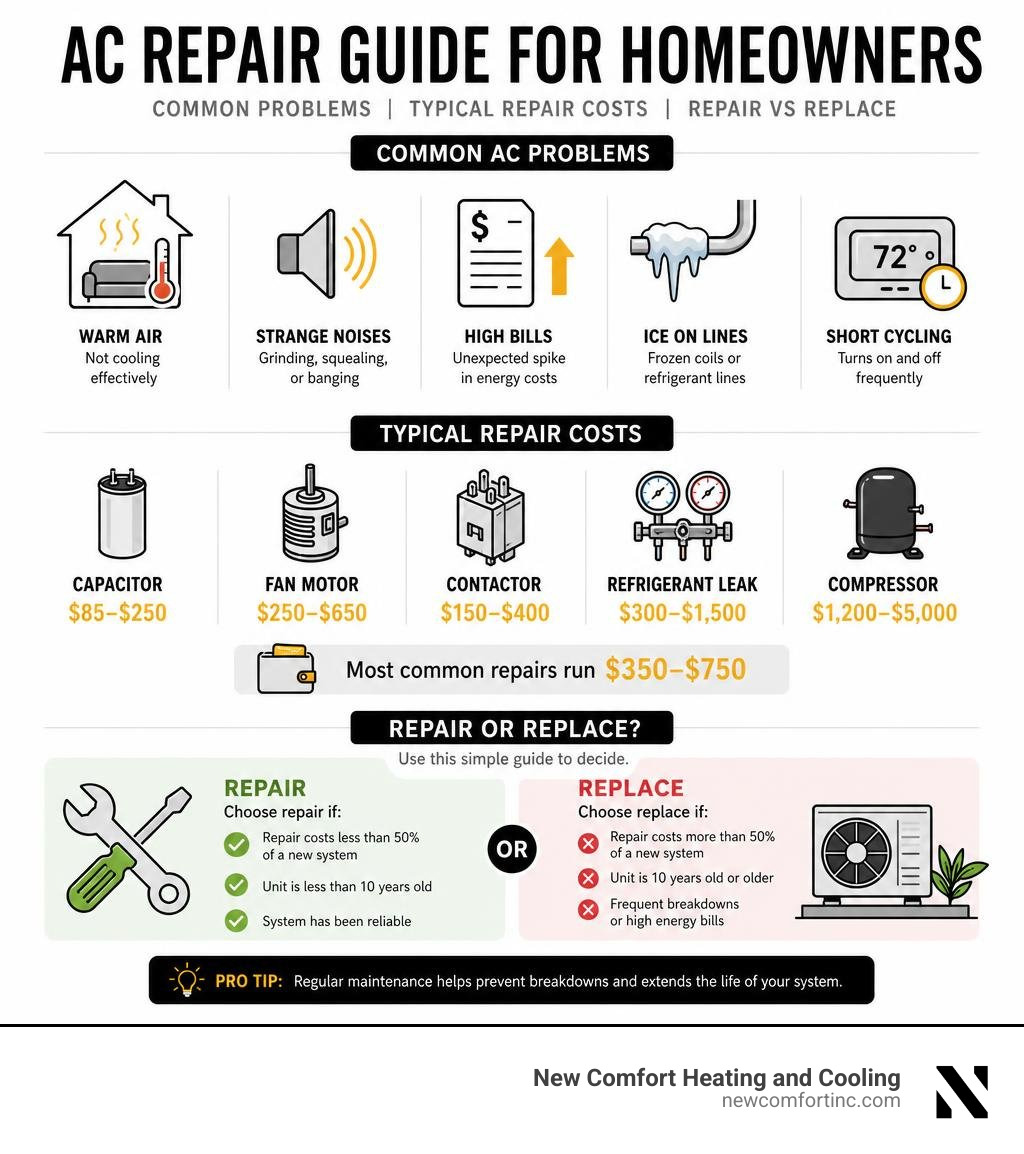
Recognizing the warning signs early can save you from a complete system breakdown. Here are the most common signs that your cooling system is struggling:
- Warm Air Blowing from the Vents: If the air coming out of your registers feels lukewarm or room-temperature, your system is not cooling effectively. This could point to a compressor issue, a failed capacitor, or a refrigerant leak.
- Short Cycling: An AC system should run in consistent cycles of 15 to 20 minutes. If your system turns on, runs for two minutes, and shuts back off, it is "short cycling." This puts immense wear and tear on your compressor.
- Unusual Noises: Squealing, grinding, banging, or clicking sounds are not normal. A squeal often indicates a bad blower belt or motor bearing, while clanging suggests a loose component inside the fan housing.
- Water Pooling or Ice Formation: If you notice water pooling around your indoor furnace/air handler unit, or if you see physical ice forming on the copper refrigerant lines outside, your system has a serious airflow or refrigerant issue.
- Spiked Electric Bills: An unexpected, dramatic jump in your monthly ComEd bill is a classic sign that your AC is working twice as hard to do half the job.
If you notice any of these symptoms, it is highly beneficial to act quickly. You can learn how to diagnose HVAC issues to get a better idea of what might be happening behind the scenes before you call in the professionals.
Common Signs You Need Urgent AC Repair HVAC Work
While some issues can wait a day or two, certain problems require immediate attention to prevent permanent damage to your equipment.
Weak airflow is a major red flag. If you can barely feel air coming out of your registers, your blower motor might be failing, or your evaporator coil could be completely frozen over. Running a system with a frozen coil can cause liquid refrigerant to flood back into your compressor, destroying it.
Thermostat issues are another common culprit. If your thermostat display is blank, or if the temperature in your home does not match the setting on the wall, the communication between your controls and your HVAC equipment has broken down. To help troubleshoot these initial headaches, we recommend you read about what to do when your AC is not working for simple steps you can take right now.
Identifying Refrigerant Leaks and R-22 System Options
Your air conditioner's refrigerant loop is a completely hermetic (sealed) system. This means your AC does not "consume" or use up refrigerant like a car uses gas. If your system is low on refrigerant, it has a physical leak.
Beware of companies that offer to simply "gas and go" — adding more refrigerant without finding and fixing the leak. Not only is this bad for your wallet, but it is also illegal under EPA regulations to knowingly vent refrigerant into the atmosphere.
If your system was installed before 2010, there is a high chance it runs on R-22 refrigerant (commonly known as Freon). As of January 1, 2020, the production and import of R-22 was completely banned in the United States. Today, servicing these older systems is incredibly expensive because technicians must rely on limited, reclaimed stockpiles of R-22.
If you have an R-22 system with a refrigerant leak, you generally have two choices:
- Repair and Recharge: Locate the leak, weld the copper lines, and recharge the system with expensive, reclaimed R-22.
- System Transition: Replace the outdated equipment with a modern system running on environmentally friendly R-410A or R-32, which are far more efficient and cheaper to maintain.
If you are unsure which path makes the most sense for your home, you can find out when to call an HVAC technician to get an honest, professional assessment of your system's condition.
What to Expect During Your Service Appointment
When you book an ac repair hvac appointment, you should expect total transparency and professionalism. You should never feel pressured or left in the dark about what is happening with your home's comfort system.

A reputable service appointment begins with a clear, flat-rate diagnostic fee. This fee covers the technician's travel time and the specialized tools required to pinpoint the exact failure. Once the issue is identified, the technician should provide you with a written diagnosis and a flat-rate quote for the repair before any work begins. This ensures there are no surprise hourly fees or hidden charges when the bill arrives.
To experience this level of transparent, customer-first service, you can schedule professional AC Repair with our local team.
The Step-by-Step AC Repair HVAC Diagnostic Process
A thorough diagnostic process is what separates true HVAC professionals from temporary quick-fixers. Here is the exact step-by-step journey our technicians take to ensure your system is repaired correctly:
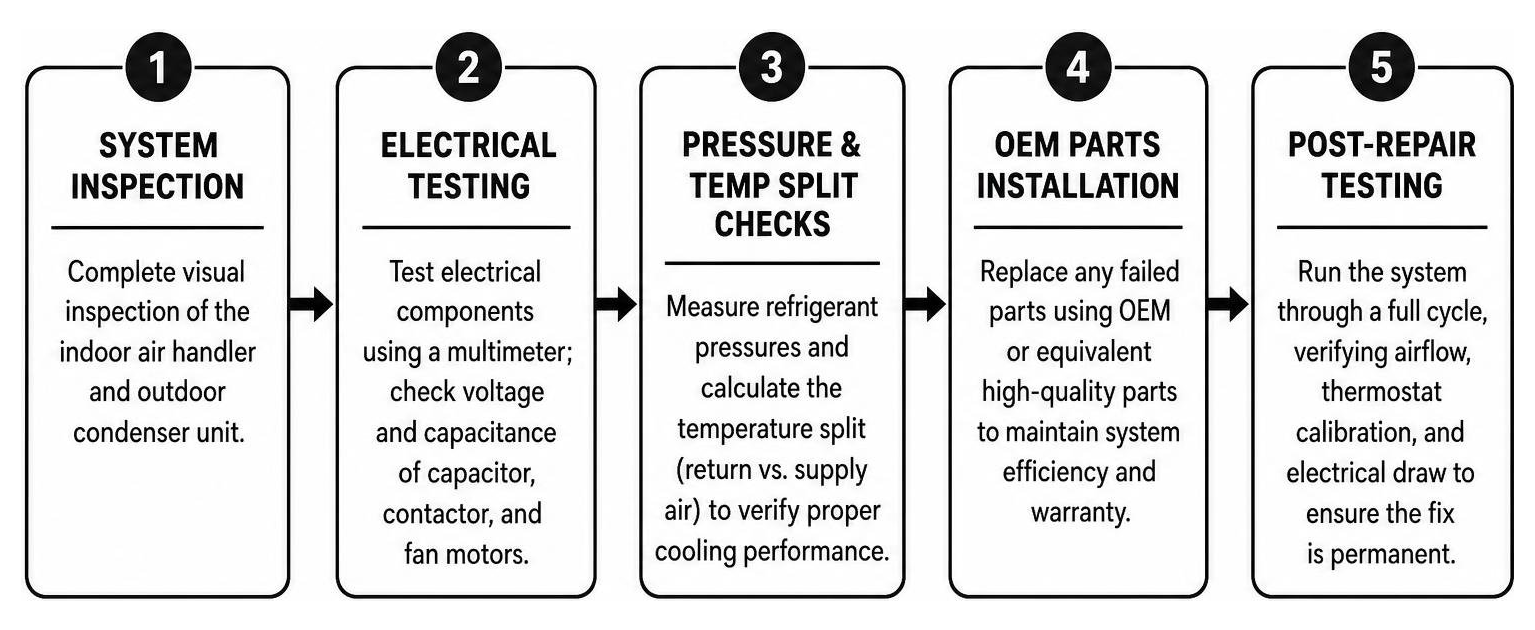
- System Inspection: We perform a complete visual inspection of both the indoor air handler and the outdoor condenser unit.
- Electrical Testing: Using a multimeter, we test the electrical components, checking the voltage and capacitance of your capacitor, contactor, and fan motors.
- Pressure and Temperature Split Checks: We measure the refrigerant pressures and calculate the "temperature split" (the difference in temperature between the air entering your return vents and the air exiting your supply vents) to verify proper cooling performance.
- OEM Parts Installation: If a part has failed, we replace it using Original Equipment Manufacturer (OEM) or equivalent high-quality parts to maintain your system's efficiency and warranty.
- Post-Repair Testing: We do not just pack up and leave once the part is in. We run the system through a full cycle, verifying correct airflow, thermostat calibration, and electrical draw to ensure the fix is permanent.
By following this rigorous process, we prevent the kind of recurring breakdowns that frustrate homeowners. To understand why these systems fail in the first place, you can discover the most common HVAC system failures and how to keep them from happening to you.
Understanding the Cost of Air Conditioning Repairs
Pricing transparency is one of our core values. We believe that homeowners deserve to know what common repairs cost without having to navigate confusing industry jargon. Below is a realistic breakdown of standard AC repair costs in the Chicago and Justice, IL markets:
| Repair Category | Description | Typical Cost Range |
|---|---|---|
| Diagnostic Fee | Standard service call to diagnose the issue | $75 – $125 |
| Capacitor Replacement | Restores power to start the compressor and fan | $350 – $500 |
| Contactor Replacement | Controls the electrical flow to the outdoor unit | $350 – $600 |
| Blower Motor Replacement | Powers the indoor fan to circulate air | $750 – $1,500 |
| Refrigerant Leak Repair & Recharge | Finding the leak, sealing it, and recharging refrigerant | $350 – $1,000 |
| Compressor Replacement | Replacing the "heart" of the air conditioning system | $3,500 – $5,000 |
While these costs can seem daunting, staying on top of repairs actually saves you money in the long run by preventing minor issues from cascading into catastrophic component failures. You can explore HVAC repair cost saving benefits to see how prompt repairs protect your budget.
Financing and Discount Options for Homeowners
We understand that an unexpected AC breakdown can put a strain on your household budget. That is why we offer flexible options to make your repairs or system replacements as affordable as possible.
For major repairs or full system replacements, 0% interest financing is available for 60 months on select high-efficiency systems. We also proudly offer 10% demographic discounts to honor our military, seniors, and first responders.
Additionally, homeowners can join our maintenance membership program. Members save 10-15% on every single repair, receive priority scheduling, and get regular tune-ups to keep their systems running at peak performance. To protect your system year-round, learn about professional AC Maintenance and how it keeps your utility bills low.
Deciding to Repair vs. Replace Your Cooling System
One of the toughest decisions a homeowner has to make is whether to keep patching up an old air conditioner or invest in a brand-new system.
To make this decision easier, we recommend using the 50% Rule: if the cost of the repair exceeds 50% of the value of a brand-new system, and your unit is over 10 years old, replacement is almost always the smarter financial move.
Modern systems are designed under strict federal SEER2 standards. Upgrading from an old, inefficient unit to a new SEER2-compliant system can slash your monthly cooling bills immediately, helping the new unit pay for itself over time. You can compare options for AC Replacement to see the efficiency ratings and equipment tiers available today.
Five Ways to Extend Your Current AC Lifespan
If your system is still in good shape and you want to keep it running smoothly for as long as possible, there are several proactive steps you can take:
- Change Your Filters Regularly: A dirty filter restricts airflow, forcing your blower motor to work harder and potentially causing your system to overheat or freeze.
- Keep Outdoor Coils Clean: Clear away leaves, grass clippings, and debris from your outdoor condenser unit to ensure proper heat transfer.
- Seal Leaky Ductwork: Did you know that leaky ducts in unconditioned spaces like attics or crawlspaces can waste 20% to 30% of your home's cooling energy? Sealing your ducts keeps that cold air where it belongs.
- Install a Programmable Thermostat: Avoid cooling an empty house by scheduling temperature setbacks when you are away.
- Schedule Annual Tune-Ups: Professional maintenance catches tiny issues like weak capacitors before they turn into costly summer breakdowns.
For more detailed tips tailored specifically to our local climate, you can read five proven ways to extend AC lifespan in northern Illinois.
Choosing the Right HVAC Partner
When your air conditioner goes out, you want to hire a company you can trust to treat your home with respect. Unfortunately, the HVAC industry is filled with high-pressure sales tactics. Many large companies send out commissioned salespeople disguised as technicians, whose main goal is to sell you an expensive $8,000 replacement system when a simple $500 capacitor repair would solve the problem.
At New Comfort Heating and Cooling, we operate differently. We are a local, family-owned business serving Chicago and Justice, IL. We stand by our work with a 90-day parts and labor warranty on all repairs, and we pride ourselves on delivering honest, straightforward answers. We treat every customer's home with the same care and integrity as if it were our own mother's house.
Frequently Asked Questions About AC Repair
Do you service all major AC brands and offer same-day service?
Yes! Our highly trained, EPA-certified technicians are fully equipped to service all major residential AC brands, including Carrier, Trane, Rheem, Goodman, Lennox, and more. Because we know how miserable a hot house can be, we offer same-day service and 24/7 live phone support to get your cool air restored as quickly as possible.
What local areas are covered for AC repair?
We proudly serve Chicago, Justice, IL, and the surrounding near-southwest suburbs. Because our dispatch trucks are fully stocked with common parts like capacitors, contactors, and fan motors, we can usually resolve your comfort issues on our very first visit.
What is included in a standard repair warranty?
All of our standard air conditioning repairs are backed by a solid 90-day warranty on both parts and labor. If the same part fails within 90 days of our service, we will return and replace it at absolutely zero cost to you.
Conclusion
You do not have to suffer through a hot, humid summer with a failing air conditioning system. Whether you need a simple capacitor replacement, a complex refrigerant leak repair, or an honest assessment on a full system upgrade, New Comfort Heating and Cooling is here to help.
Don't wait for your system to break down completely. Contact our team today to schedule your diagnostic appointment, and make sure your home stays comfortable all year long. And remember, when winter rolls back around, we are also here to keep you warm — explore our furnace repair services to see how we maintain your comfort through every season.